sales@sterlitech.com 1-877-544-4420
Your cart is empty.

Membrane Filtration

  • Now with Custom Sample Packs!

    Posted on November 17, 2011 by Sterlitech Corporation

    You can now create and order a customized sample pack for any of our membrane disc filter materials through the Sterlitech website! We’ve always been happy to provide these sample packs for our customers to experiment with and now it’s easier than ever to acquire the filters you want.

    Get started by visiting our Membrane Filter Sample Packs page and choosing the material you wish to sample. From the material page build your sample pack by selecting the pore size/diameter combinations you want to try from the drop down menus. Each sample pack contains five pore size/diameter combinations of two filters each, for a total of ten filters per sample pack.

    If you want to sample five different pore sizes and diameters, you can. If you want all ten filters to be identical, you can do that too. The custom sample packs operate on a flat pricing structure, so there’s no added cost for mixing different options.

    If you still can’t find the sample option you need, contact one of our reps and we’ll help you out. Happy sampling!


    This post was posted in Membrane Filtration, Website Features

  • Membrane Industry to Double by 2020

    Posted on November 15, 2011 by Sterlitech Corporation

    A new report from Lux Research indicates that the worldwide market for membranes is expected to nearly double by 2020, from $1.5 billion to $2.8 billion (USD). One of the main reasons for this growth is advancements in membrane technology which will increase their utility. Improvements in fouling resistance and chemical tolerance open the door for membranes to be used in applications that they couldn’t perform before, such as industrial water treatment.

    Another reason for optimism in the membrane industry is the continued market strength in the industries that purchase membranes. The food & beverage, pharmaceutical, desalination, environmental, and biotechnology sectors all commonly use membranes in their processes and are all expected to continue growing in the United States and around the world.

    What do you think? Do you see yourself using membranes more often 10 years from now?

    Also visit Filtration + Separation for more information on this report.


    This post was posted in Filtration, Membrane Filtration, News

  • Testing Compatibilities of Filter Media with Liquids

    Posted on October 6, 2011 by Sterlitech Corporation

    For a nice overview of some basic questions to ask before you select your liquid filtration medium, take a look at this two page paper from the American Filtration & Separations Society. It starts with clear definitions of permeability and efficiency, and then segues into the importance of compatibility between the filter material and the liquid.

    One of their good points worth repeating here is that for many types of sampling there are pre-existing industrial or organizational standards to guide you. With most of our membrane, syringe, and capsule filters, you can find this information under the “Application” tab for a particular item. Our resources section is another good place to research this information. Want more help? You can always ask one of our technical personnel for added assurance.

    Read the complete AFS guide here.


    This post was posted in FAQ, Membrane Filtration

  • Uses for Cytoclear Glass Slides

    Posted on September 7, 2011 by Sterlitech Corporation

    Cytoclear Glass SlidesHave you ever had difficulty observing the results of microscopic work performed with polycarbonate (PCTE) or polyester (PETE) membrane filters? If so, our Cytoclear Glass Slides can help. These glass slides are frosted with a light-diffusing treatment which makes it possible to directly observe aqueous biologicals such as phytoplankton under standard (non-inverted) microscopy or to correct light refraction that can occur when analyzing bacteria on black polycarbonate filters.

    For other applications where you’re looking at filters through a microscope, the cytoclear slides can help you avoid eye strain by reducing distracting lines or shadows that can occur.

    Whatever your reasons for using them, you can automatically save 50% this month on cytoclear glass slides or any other membrane accessory when you order them along with any of our polycarbonate or polyester membrane filters!

    You can learn more about these applications for cytoclear glass slides by reading this article on phytoplankton observation or this one on aquatic bacteria.


    This post was posted in applications, Membrane Filtration

  • Disposable Vacuum Filters

    Posted on August 25, 2011 by Sterlitech Corporation

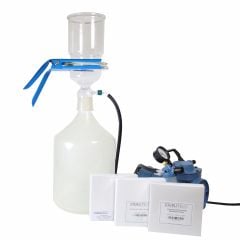
    More new product goodness arrives in the form of Disposable Vacuum Filters. These ready-to-use filters contain a PES membrane that provides high flow-rates and throughput for rapid filtration of tissue culture media, buffers, additives and aqueous biologicals. Consider using these filters when quick, cost-efficient filtration is of the utmost importance.

    They are available now as bottle top only units or with a receiver flask (pictured here with receiver flask attached). Head over to the product page to view the full specs.


    This post was posted in Membrane Filtration, News

  • New Products - Hollow Fiber Membranes, Spin Columns

    Posted on August 15, 2011 by Sterlitech Corporation

    No summer weather in Seattle means no summer break for us! We’re continuing our hectic schedule by adding a pair of new products to our catalog. First up is the Hollow Fiber Membranes for rapid clarification of small volumes. This unique line from WaterSep Bioseparations is made with a polyethersulfone (PES) membrane and comes in a variety of molecular weight cut-offs for different applications like cell harvesting or protein concentration. Consider these hollow fiber membranes when you need to perform a simple crossflow filtration.

    The other new product we added is a series of Spin Columns to easily concentrate, separate, or purify samples in the ultrafiltration range. We have reusable and disposable units available depending what you need. What makes them even easier to use is that they are compatible with our UF flat sheet membranes, so you can get all your equipment in the same place!


    This post was posted in Membrane Filtration, News

  • Static Eliminators

    Posted on July 18, 2011 by Sterlitech Corporation

    Of all the membrane disc filter accessories that we carry, the static eliminator probably gets the most technical questions. Whereas items like the cytoclear glass slides and stainless steel membrane filter tweezers are very straightforward in their purpose and operation, how a static eliminator works may not be as intuitive.

    Static eliminators are used on Polycarbonate or Polyester membranes when they are going to be subject to precise analytical balance measurements that could be affected by the presence of static or dust particles on the filter. Static eliminators can perform this function in a few different ways, such as by using alternating current or by using small amounts of a radioactive element to remove electrons. The static eliminators that we carry use a naturally occurring radioactive element called Polonium-210 (It was discovered by Marie and Pierre Curie and named after Marie Curie’s homeland of Poland) in order to function.

    This type of static eliminator is referred to as an alpha ionizer since it emits alpha particles (Helium in this case) which create an intrinsically balanced output of positive and negative ions to remove the static charge. The reason our static eliminators utilize this method is because alpha ionizers don’t require an electrical power supply, which is more convenient and safer for volatile environments.

    Now even though we mentioned that our static eliminators contain this radioactive material (and that said material was discovered by Marie Curie), this item poses no health risk, as the alpha particles will not pass through the skin and the element is sealed. According to the International Atomic Energy Agency, “Po-210 [Polonium-210] is not a concern and Po-210 does not represent a risk to human health as long as Po-210 remains outside the body.” Since the alpha particles can only travel a few centimeters and they are easily blocked by the skin or even a sheet of paper, safety concerns are minimal. Furthermore, the static eliminators we carry are manufactured and distributed in accordance with the provisions provided by the U.S. Nuclear Regulatory Commission, so you can use them without worry!


    This post was posted in Membrane Filtration

  • What the Crap?

    Posted on June 22, 2011 by Sterlitech Corporation

    Biogas, a form of renewable energy this is produced through, among other things, animal and human waste (hey, it’s not like you were using it) is one of several developing energy sources whose proponents are exploring membrane separation techniques to improve their purification process. A recent study published in the “Applied Chemistry – A Journal of the Society of German Chemists” experimented with a new method of membrane separation called the “condensing-liquid membrane” (or CLM) in an effort to enrich raw biogas, which typically contains between 50-80% methane, to natural gas quality (at least 95% methane content), with favorable results.

    Common membrane materials like Cellulose Acetate and Polyimide have been tried for this application with some success, but the problem is that they can be ruined by the aggressive gases that are present in raw biogas, such as carbon dioxide and hydrogen sulfide. The CLM is a liquid (water in this case) layer that condenses on a porous hydrophilic membrane which then gets regenerated to allow for continuous operation. This support, made from Teflon, gathers water vapor from the biogas on the feed side of the membrane and is partially removed from the permeate side by nitrogen gas, thus allowing for separation to occur in one step as the water is constantly refreshed. One of the more brilliant aspects of the CLM method is that the presence of water in biogas, usually regarded as a disadvantage, suddenly becomes a key component in the process.

    Since the membranes are being preserved and not destroyed, the potential exists for this process to be a cost-efficient method of purifying biogas in the future. Researchers will continue to investigate the CLM method in order to find the optimal conditions that will make it even more efficient.

    Visit here to read the full report “Effective Purification of Biogas by a Condensing-Liquid Membrane.”

    To learn more about biogas, try this site from Alternative Fuels and Advanced Vehicles Data Center and the U.S. Dept. of Energy.

    How does a biogas plant work? Watch this animated video to get an idea.


    This post was posted in Filtration, applications, waste and wastewater treatment, Membrane Filtration, Teflon, renewable energy, hydrophilic, separation, biogas

  • Deadliest Catch: Man-Made Pollution

    Posted on June 16, 2011 by Sterlitech Corporation

    Cruising around the Scandinavian coastline in November might not sound like the most ideal place to conduct an environmental impact study, but for Norway’s Institute of Marine Research it was necessary in order to investigate the levels of anthropogenic particles in the Skagerrak strait. As you can imagine, this setting presented some unique challenges for the research team. In order to gather and analyze microscopic samples from this body of water, which is located between Norway, Denmark and Sweden, researchers had to come up with some new sampling methods and fashion their own equipment to solve problems that had plagued previous studies.

    Norwegian Researchers Hard at Work^

    One key obstacle that these scientists needed to overcome was how to distinguish between anthropogenic particles, which are man-made bits of matter that impact the environment (i.e. oil-spill droplets, asphalt, rubber tire wear, fly ash), from those particles with similar characteristics which appear naturally (volcanic ash, peat). To make this distinction, the samples were subjected to morphology analysis of their color and texture to first determine their origin before being counted.

    The second major challenge was how to prevent contamination, which is easier said than done considering the harsh and unpredictable nature of the sea. One of the steps the researchers took to solve this was to develop control samples, free of any contaminants, which they could actually bring on board the ship with them. To further reduce the potential of contaminating samples, they also created new methodology and constructed their own customized sampling apparatus.

    You can see a schematic of the sampling equipment the Institute researchers built in their published study. Their setup involved a submersible water pump that was positioned inside a waterproof case connected to the sampling filter (10 μm hydrophobic polycarbonate membrane filters, along with a 30 μm square mesh nylon filter as a support) which was placed directly in the sea. To protect the filter from wave turbulence they modified one of our filter holders (this one) with a new outlet fitting and a larger, semi-enclosed inlet with a smooth surface. The filters were also placed in protective holders before and after filtration for protection and to reduce the risk of contamination. As an added protective measure, the filter apparatus was ultrasonically cleaned prior to use. The entire sampling apparatus was held 2 meters outside the boat (to further prevent contamination) and the sampling depth was limited to between 0.1 and 1.5 meters to protect it from large waves.

    While it will take many more studies before conclusions can be drawn about the state of this particular body of water, the scientists were encouraged by the results of the new methodology they created. They note in the conclusion how these improvements have standardized the sampling and reduced the risk of contamination. The scientists also suggest that this sampling equipment could be adapted for larger particles.

    To read the full study, visit here.
    ^Image from Survey of microscopic anthropogenic particles in Skagerrak. Lysekil and Flødevigen 2010-11-20, Institute of Marine Research.


    This post was posted in applications, Membrane Filtration, environmental lab, pollution, general science

  • New Item - Quartz Fiber Filters

    Posted on April 12, 2011 by Sterlitech Corporation

    Quartz Fiber Filters for High Temp. Needs

    This week we added another new item to our catalog - Quartz Fiber Filters. These filters are especially useful for high temperature filtration applications since they can withstand temperatures over 500°C.

    Other nice things about these filters include their indefinite storage life and their high chemical resistance. Right now we have grades QR100 and QR200 available in diameters ranging from 21mm to 150mm.


    This post was posted in Filtration, Membrane Filtration, News, Quartz Fiber Filter, Glass Fiber Filter

Items 1 to 10 of 13 total

Page:
  1. 1
  2. 2