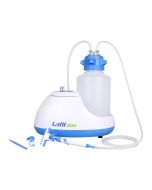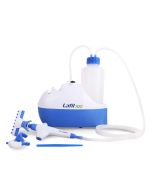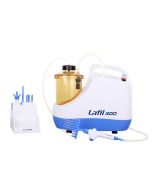
Which Lab Aspiration System Is Right for You?

In any laboratory setting, efficient liquid waste disposal is essential for maintaining a safe and contamination-free workspace. Lab aspiration systems play a crucial role in removing supernatants, culture media, and other liquid waste, but with multiple options available, selecting the right system for your workflow can be challenging. Explore a comparison of lab aspiration systems designed to help you identify the right fit for your needs.
A vacuum aspiration system commonly used in cell culture labs typically consists of the following components:
- Vacuum flask: This container is used to collect aspirated liquid.
- Safety bottle: Its purpose is to prevent the liquid from being drawn into the vacuum source or vacuum pump.
- Filter: A 0.22µm filter prevents particles and maintains optimal suction efficiency.
- Vacuum source / aspiration pump: This device creates the necessary vacuum or negative pressure to aspirate the liquid when the pipes are connected.
Selection Criteria:
The optimal aspiration system is contingent upon the specific needs of the laboratory. Key considerations include:
- Liquid Volume: The volume of liquid to be aspirated.
- Aspiration Precision: The required accuracy and consistency of liquid removal.
- System Portability: The need for mobility and field applications.
- Budgetary Constraints: The available financial resources.
- Safety Requirements: The necessity for filtration and containment features.
Laboratories employ various methods for liquid aspiration and suction. Traditionally, pipettes were widely used for liquid removal. However, this manual approach often led to muscle strain or even injury due to repetitive press-and-release motions. It also required a significant number of disposable pipette tips, raising environmental concerns.
In contrast, modern labs increasingly rely on self-installed vacuum aspirators, which offer greater efficiency compared to traditional pipetting. However, improper piping layouts and the use of fragile glass flasks and tubing can introduce safety risks in the laboratory. Here is a quick comparison of these various types of aspiration systems:
System Type |
Ideal For |
Pros |
Cons |
| Manual Aspiration Pumps | Low-volume labs with occasional aspiration needs | Budget-friendly, easy to use, no power needed | Labor-intensive, limited suction power |
| Vacuum Pump-Based Systems | Labs requiring precise suction control | Adjustable suction, efficient for multiple users | Requires reliable vacuum source, potential noise |
| Integrated Systems (e.g., Rocker BioDolphin) | Labs handling biological waste & cell culture work | Built-in vacuum pump, filtration, quiet operation, precise control | Higher upfront cost, but increased efficiency |