
Shims and Spacers: Why They Are Needed, And How Are They Used
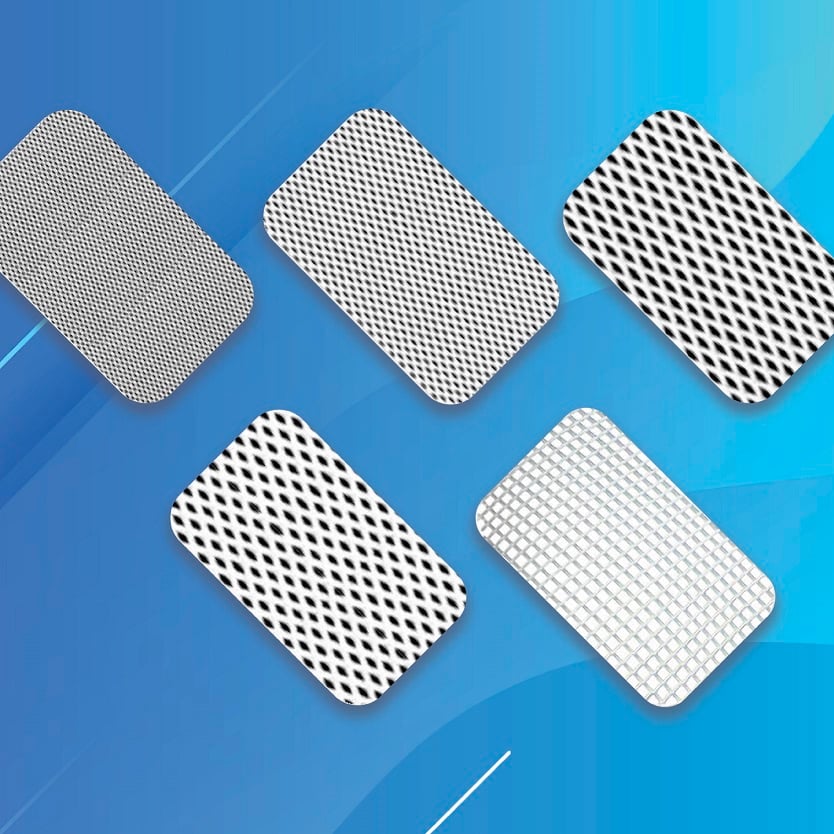
Spacer is an essential component in a commercial scale membrane filtration process. It is used to provide a separation layer between membrane leaves in spiral wound membrane elements and offer a layer of support. Spacers are usually made of Polypropylene and produced in various geometries, thicknesses, and sizes, to allow for optimum enhancement of membrane process performance. They enhance the mixing within the feed channel to increase the mass transfer by reducing the concentration polarization [1]. Also, they can reduce the membrane fouling effect in some applications [2].
Spacers are also used in lab scale membrane filtration processes to mimic actual membrane operations, in addition to the advantages mentioned earlier such as enhancing mass transfer and fouling reduction. Shims are thin flat sheets made from 316L stainless steel and placed on the feed side of a lab scale cell as shown in Figure 1. They are produced in various thicknesses and sizes, allowing for controlled adjustments to the flow channel depth in membrane cells. Shims are primarily used to increase the crossflow velocity (CFV) by reducing the depth of the flow channel.
While shims and spacers are effective in solving various challenges in membrane processes, they also increase the pressure drop across the channel [3]. An increased pressure drop may negatively impact the overall efficiency of the membrane process. Therefore, selecting appropriate shims and spacers is crucial for balancing membrane performance enhancement with the effect of pressure drop.
What is the purpose of shims used with the membrane test cells, and how do I choose the right one?
Shims are used to increase the Crossflow velocity, which refers to the linear rate of flow of the feed solution as it passes through the feed solution channel. Crossflow velocity is calculated by dividing the volumetric flow rate of the feed solution by the cross-sectional area of the flow channel. Placing a shim inside the flow channel reduces the flow channel depth which in turn increases the crossflow velocity. A higher crossflow velocity helps reduce the fouling rate and minimize the effect of concentration polarization [4]. While shims are not mandatory for operating a membrane process, they can be used to enhance the performance of the membrane filtration process. Sterlitech offers a wide range of shims in various sizes, suitable for a variety of cells. Selection of shim thickness is determined by the spacer selected. It is mandatory to leave a small amount of headspace in the cavity after the membrane is installed for cross flow cells to operate efficiently.

Figure 1: Arrangement of shims and spacers within the flat sheet crossflow cell
Why are spacers important for membrane processes, and is there an ideal choice?
Spacers provide various benefits in a membrane process. Similar to shims, inserting feed spacers reduces the channel’s cross-sectional area. Since feed spacers come in a wide range of thicknesses and percentage open area, the cross-sectional area is ultimately determined by the thickness of the selected spacer and its percentage of open area. The feed spacer is expected to minimize concentration polarization and enhance the mass transfer coefficient [5]; however, it may negatively impact the membrane process by increasing the pressure drop [6]. Although spacers are designed to reduce concentration polarization, they are widely used to reduce fouling effects [7]. It has been found that using spacers can reduce the effect of biofouling in membranes, attributed to the initial deposition of foulants along spacer openings [3]. Regions with low hydrodynamic mixing are most conducive to microbial attachment as demonstrated in Figure 2.

Figure 2: The impact of using spacers to reduce membrane biofouling by creating dead zones
How to Select a Membrane Spacer?
Sterlitech offers a wide selection of membrane spacers to suit your application. There are two key factors that you need to be aware of when selecting feed spacers. First, the thickness of the spacer will affect spacer’s blockage — a thicker spacer can cope with more particulates and bigger particles without getting blocked. Second, you need to consider that feed spacer thickness also affects crossflow velocity.
Thinner feed spacers may lower crossflow velocities but are more prone to getting blocked. Whereas thicker feed spacers can handle larger particulates, and more of them, with less clogging, but also have higher crossflow velocities.
Thinner feed spacers are associated with lower crossflow velocities, but are more prone to clogging. Whereas thicker feed spacers can handle larger particulates, with less clogging, but also have higher crossflow velocities. But this all depends on the type of flow (turbulent or laminar) which in turn is influenced by the geometry of the feed spacer as well as the crossflow velocity of the feed solution. When the flow is turbulent, the likelihood of particulates being swept away rather than accumulating on the membrane is greater. This in turn prevents concentration gradients from forming that can cause scaling. As a rule of thumb, if particulate loads are medium to high, then thicker feed spacers will result in higher concentrate flows. On the other hand, if particulate loads are low, then thinner spacers might be more suitable.
Summary
The effective use of shims and spacers can enhance membrane process performance by optimizing crossflow velocity and reducing fouling. Understanding the relationship between spacer thickness, geometry, and pressure drop is essential for selecting the right shims and spacers. Sterlitech provides a comprehensive range of shims and spacers designed to meet the specific needs of various membrane systems.
References
[1] J. Schwinge, D. E. Wiley, and A. G. Fane, “Novel spacer design improves observed flux,” Journal of Membrane Science, vol. 229, no. 1–2, pp. 53–61, Feb. 2004, doi: 10.1016/j.memsci.2003.09.015.
[2] H. S. Abid, D. J. Johnson, R. Hashaikeh, and N. Hilal, “A review of efforts to reduce membrane fouling by control of feed spacer characteristics,” Desalination, vol. 420, pp. 384–402, Oct. 2017, doi: 10.1016/j.desal.2017.07.019.
[3] X. Qian, A. Anvari, E. M. V. Hoek, and J. R. McCutcheon, “Advancements in conventional and 3D printed feed spacers in membrane modules,” Desalination, vol. 556, p. 116518, Jun. 2023, doi: 10.1016/j.desal.2023.116518.
[4] F. Ricceri, B. Blankert, N. Ghaffour, J. S. Vrouwenvelder, A. Tiraferri, and L. Fortunato, “Unraveling the role of feed temperature and cross-flow velocity on organic fouling in membrane distillation using response surface methodology,” Desalination, vol. 540, p. 115971, Oct. 2022, doi: 10.1016/j.desal.2022.115971.
[5] S. K. A. Al-Amshawee and M. Y. B. M. Yunus, “Impact of membrane spacers on concentration polarization, flow profile, and fouling at ion exchange membranes of electrodialysis desalination: Diagonal net spacer vs. ladder-type configuration,” Process Safety and Environmental Protection, vol. 191, pp. 197–213, Mar. 2023, doi: 10.1016/j.cherd.2023.01.012.
[6] L. Gurreri, A. Tamburini, A. Cipollina, G. Micale, and M. Ciofalo, “Pressure drop at low Reynolds numbers in woven-spacer-filled channels for membrane processes: CFD prediction and experimental validation,” DESALINATION AND WATER TREATMENT, vol. 61, pp. 170–182, Jan. 2017, doi: 10.5004/dwt.2016.11279.
[7] H.-G. Park, S.-G. Cho, K.-J. Kim, and Y.-N. Kwon, “Effect of feed spacer thickness on the fouling behavior in reverse osmosis process — A pilot scale study,” Desalination, vol. 379, pp. 155–163, Feb. 2016, doi: 10.1016/j.desal.2015.11.011.


