
Maximizing Throughput in Vacuum and Pressure Filtration
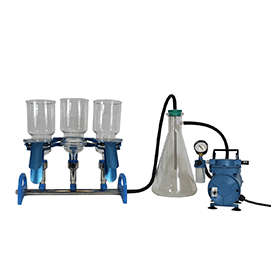
A large part of extracting commercially important compounds from various materials involves passing a type of solvent over the substance, then filtering out any unwanted debris and by-products. This filtration step can be difficult to optimize if too many undesirable compounds are also extracted; so how can you streamline the process?
Many industries rely on solvent-based extraction methods to obtain key compounds for research, pharmaceuticals, food production, and other applications. These processes often use liquefied butane, supercritical CO2, or cold ethanol to isolate target compounds efficiently. However, secondary filtration is essential to remove unwanted debris, lipids, and other particulates to ensure a high-purity final product.
Our filtration kits and related 90mm diameter membranes have proven highly effective in achieving clean extracts, particularly in solvent-based extractions, and can yield about 2-4 liters of filtered solution in approximately 20 minutes. However, when higher throughput is needed, a single filter kit may not be sufficient. While large filter cartridge assemblies might seem like an obvious solution, they may not always be the best approach. Whether using a vacuum-driven or pressure-driven system, key considerations include efficiency, cost, and complexity.
Vacuum filtration systems are widely used in laboratories due to their simplicity, ease of use, and cost-effectiveness. These systems are compatible with various membrane filters, making them suitable for diverse applications. A single vacuum filtration setup can typically process up to 1 liter at a time, though this can be increased to 4 liters with a larger receiver flask.
Pressure-driven systems, on the other hand, offer advantages such as higher processing volumes and increased pressure capacity. These systems are commonly used in applications like water treatment and petrochemical processing, where the added complexity and cost are justified. They often require multiple control valves, bypass lines, relief valves, and high-pressure pumps, making them more intricate than vacuum-driven systems.
For those requiring increased filtration capacity without the complexity of a pressure-driven setup, a manifold system may be the ideal solution. Sterlitech recently introduced a 3-place manifold kit designed to work alongside a trio of 90mm diameter glass filter funnels. This configuration effectively triples the filtration capacity of a standard single-place system, significantly increasing throughput without adding excessive operational complexity.
Manifold systems offer an efficient way to enhance filtration speed while reducing downtime and lowering per-unit processing costs. By implementing these systems, laboratories and production facilities can improve their workflow, increase efficiency, and achieve higher yields in their filtration processes.
To learn more about these filtration setups and how they can enhance your operations, ask one of our experts today.


