Applications and Development of High Pressure Reverse Osmosis

Industrial wastewater treatment presents unique challenges due to complex feed compositions and high salt concentrations. Traditionally, safe disposal or reuse of such wastewater has aimed to minimize environmental risks while conserving freshwater resources
Industrial wastewater treatment presents unique challenges due to complex feed compositions and high salt concentrations. Traditionally, safe disposal or reuse of such wastewater has aimed to minimize environmental risks while conserving freshwater resources
For instance, in offshore oil and gas operations, produced water is often treated with moderate technologies—such as dissolved air flotation or chemical precipitation—before ocean discharge. Inland, this wastewater may be reused for hydraulic fracturing. However, when these options are not viable, industries use deep well injection or evaporation ponds—methods that are expensive, land-intensive, and carry serious environmental risks such as groundwater contamination. To address these limitations, industries are increasingly turning to Zero Liquid Discharge (ZLD) strategies. ZLD aims to eliminate liquid waste entirely by recovering water and converting remaining solids into disposable or reusable forms. The core of ZLD systems is desalination, which separates clean water from saline waste. This can be achieved using membrane-based processes like reverse osmosis (RO) or thermal technologies such as multi-effect distillation (MED), multi-stage flash (MSF), and mechanical vapor compression (MVC).
High-Pressure Reverse Osmosis Mechanism and Challenges
Reverse osmosis has emerged as a leading method for desalination due to its superior energy efficiency. RO operates by applying high pressure to saline water, forcing it through a semi-permeable membrane that retains salts and other impurities. However, conventional RO systems are generally limited to treating water with total dissolved solids (TDS) up to ~70,000 mg/L, due to pressure constraints (usually capped at 80 bar). For more concentrated hypersaline brines, which can exceed TDS levels of 250,000 mg/L, traditional RO is insufficient. In such cases, energy-intensive thermal methods are employed, significantly increasing operational costs. This is where High-Pressure Reverse Osmosis (HPRO) enters the picture. HPRO refers to RO systems operating at pressures above 100 bar, enabling the treatment of hypersaline brines that were previously untreatable by conventional membrane technologies. HPRO offers promising energy efficiency of RO while extending its capability to desalinate more concentrated waste streams. By achieving higher retentate concentrations, HPRO can reduce the volume of brine requiring thermal treatment, ultimately lowering the overall cost and environmental impact of ZLD systems. While the promise of HPRO is clear, several hurdles remain. Material and design limitations, particularly in membrane durability and energy recovery systems, must be addressed. Further research is needed to optimize system configurations, improve membrane materials, and ensure operational safety at ultra-high pressures.
Sterlitech’s Role in Advancing HPRO Technologies
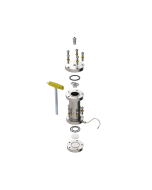
At Sterlitech, we offer a wide range of solutions specifically designed to support the testing and optimization of High-Pressure Reverse Osmosis (HPRO) processes. From early-stage membrane dead end evaluation to crossflow testing, our equipment is built to perform under the harsh conditions associated with hypersaline water treatment. For preliminary tests, the HP4750X stirred cell, constructed from Hastelloy, is an excellent tool. It is capable of operating at pressures up to 2500 psi, making it ideal for simulating the high-pressure environments required in HPRO applications. Its corrosion-resistant construction ensures compatibility with aggressive brine solutions, providing long-term durability and reliable performance in harsh chemical conditions. After completing preliminary flat-sheet testing, researchers and engineers can transition to crossflow filtration using our Hastelloy crossflow skids. These robust systems are available in a variety of configurations and materials to meet different testing requirements. They support both flat-sheet membranes and 1812 spiral-wound elements, offering flexibility for evaluating membrane performance in flat-sheet and spiral wound modes. Designed to withstand operating pressures up to 2000 psi, these skids provide excellent corrosion resistance and mechanical stability for extended testing.
Sterlitech’s high-pressure testing systems are engineered to accelerate the development and scale-up of HPRO technologies. Whether you're working on membrane development, selection, optimizations, or system design, our equipment offers the convenience and durability needed to advance your research. Want to learn more? Ask an expert to discuss your filtration challenge.
Industrial wastewater treatment presents unique challenges due to complex feed compositions and high salt concentrations. Traditionally, safe disposal or reuse of such wastewater has aimed to minimize environmental risks while conserving freshwater resources
For instance, in offshore oil and gas operations, produced water is often treated with moderate technologies—such as dissolved air flotation or chemical precipitation—before ocean discharge. Inland, this wastewater may be reused for hydraulic fracturing. However, when these options are not viable, industries use deep well injection or evaporation ponds—methods that are expensive, land-intensive, and carry serious environmental risks such as groundwater contamination. To address these limitations, industries are increasingly turning to Zero Liquid Discharge (ZLD) strategies. ZLD aims to eliminate liquid waste entirely by recovering water and converting remaining solids into disposable or reusable forms. The core of ZLD systems is desalination, which separates clean water from saline waste. This can be achieved using membrane-based processes like reverse osmosis (RO) or thermal technologies such as multi-effect distillation (MED), multi-stage flash (MSF), and mechanical vapor compression (MVC).
High-Pressure Reverse Osmosis Mechanism and Challenges
Reverse osmosis has emerged as a leading method for desalination due to its superior energy efficiency. RO operates by applying high pressure to saline water, forcing it through a semi-permeable membrane that retains salts and other impurities. However, conventional RO systems are generally limited to treating water with total dissolved solids (TDS) up to ~70,000 mg/L, due to pressure constraints (usually capped at 80 bar). For more concentrated hypersaline brines, which can exceed TDS levels of 250,000 mg/L, traditional RO is insufficient. In such cases, energy-intensive thermal methods are employed, significantly increasing operational costs. This is where High-Pressure Reverse Osmosis (HPRO) enters the picture. HPRO refers to RO systems operating at pressures above 100 bar, enabling the treatment of hypersaline brines that were previously untreatable by conventional membrane technologies. HPRO offers promising energy efficiency of RO while extending its capability to desalinate more concentrated waste streams. By achieving higher retentate concentrations, HPRO can reduce the volume of brine requiring thermal treatment, ultimately lowering the overall cost and environmental impact of ZLD systems. While the promise of HPRO is clear, several hurdles remain. Material and design limitations, particularly in membrane durability and energy recovery systems, must be addressed. Further research is needed to optimize system configurations, improve membrane materials, and ensure operational safety at ultra-high pressures.
Sterlitech’s Role in Advancing HPRO Technologies
At Sterlitech, we offer a wide range of solutions specifically designed to support the testing and optimization of High-Pressure Reverse Osmosis (HPRO) processes. From early-stage membrane dead end evaluation to crossflow testing, our equipment is built to perform under the harsh conditions associated with hypersaline water treatment. For preliminary tests, the HP4750X stirred cell, constructed from Hastelloy, is an excellent tool. It is capable of operating at pressures up to 2500 psi, making it ideal for simulating the high-pressure environments required in HPRO applications. Its corrosion-resistant construction ensures compatibility with aggressive brine solutions, providing long-term durability and reliable performance in harsh chemical conditions. After completing preliminary flat-sheet testing, researchers and engineers can transition to crossflow filtration using our Hastelloy crossflow skids. These robust systems are available in a variety of configurations and materials to meet different testing requirements. They support both flat-sheet membranes and 1812 spiral-wound elements, offering flexibility for evaluating membrane performance in flat-sheet and spiral wound modes. Designed to withstand operating pressures up to 2000 psi, these skids provide excellent corrosion resistance and mechanical stability for extended testing.
Sterlitech’s high-pressure testing systems are engineered to accelerate the development and scale-up of HPRO technologies. Whether you're working on membrane development, selection, optimizations, or system design, our equipment offers the convenience and durability needed to advance your research. Want to learn more? Ask an expert to discuss your filtration challenge.