
Scaling Up Filtration Processes with Capsule Filters
· Filtration Resources
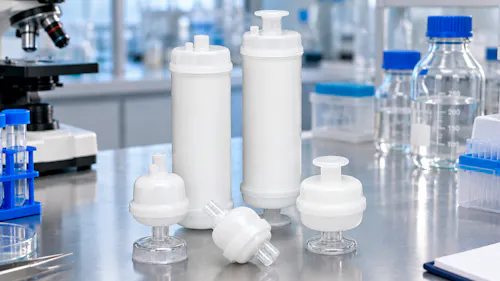
Membrane disc filtration is widely used in laboratory applications where relatively small volumes of liquid need to be processed. However, as filtration volumes increase, the limited surface area of conventional membrane discs can lead to more frequent filter replacements, additional handling, and interruptions to processing.
Capsule filters offer a practical solution for applications requiring higher throughput. By providing greater effective filtration area in a self-contained, disposable format, they can accommodate larger processing volumes while simplifying filter changeouts and integration into existing filtration systems.
A Simple Solution: Scale Up with Capsule Filters
Increasing the effective filtration area allows a higher throughput volume while reducing how often the filter media must be replaced. Capsule filters make it easy to scale up and gain exactly that.
Increase Effective Filtration Area (EFA)
While a 293 mm membrane disc—one of the largest standard sizes commercially available—provides approximately 0.7 ft² of effective filtration area, capsule filter configurations can offer up to 5.9 ft², providing substantially greater filtration capacity within a single unit.
This represents more than eight times the available filtration area, potentially supporting greater processing volumes and reducing the frequency of filter replacements.
Media Format | Effective Filtration Area (sq ft) |
|---|---|
293 mm membrane disc | 0.7 |
Small Capsule Filter (3.5” length) | 0.8 |
Medium Capsule Filter (8.8” length) | 3.0 |
Large Capsule Filter (12.8” length) | 5.9 |
Increasing effective filtration area can support higher flow rates under comparable operating conditions and increase the total volume processed before filter replacement becomes necessary.
Compact Construction for Higher Pressure Tolerance
As filtration progresses, retained particles may accumulate on or within the membrane, restricting fluid passage and increasing resistance to flow. In constant-flow systems, this typically results in a gradual increase in differential pressure, while constant-pressure systems experience a decline in flow rate.
Capsule filters designed to withstand higher differential pressures may offer an operational advantage under these conditions. As portions of the membrane become fouled, the remaining permeable regions can continue supporting fluid flow. Where the filtration system permits, increasing differential pressure within the manufacturer's specified limits may help compensate for rising resistance and maintain acceptable processing rates.
Membrane Material and Chemical Compatibility
Increasing effective filtration area and allowable differential pressure can help accommodate the higher throughput demands of scaled-up processes. However, successful scale-up also requires selecting a membrane material that maintains reliable performance under the intended operating conditions and exposure to different types of solvents.
With membrane material options such as PES, PTFE, nylon (NY), and polypropylene (PP), capsule filters provide flexibility across different fluid chemistries and filtration objectives, that helps users select the material most compatible with the intended application.
Membrane | Key characteristics | Potential applications |
|---|---|---|
Hydrophilic, generally high aqueous permeability | Buffers and aqueous solutions | |
Hydrophobic, broad chemical resistance | Compatible solvents and gas filtration | |
Hydrophilic, versatile filtration properties | Selected solvents and process liquids | |
Broad chemical resistance for many fluids | Chemical processing and prefiltration | |
Depth-filtration characteristics and particulate loading capacity | Clarification and prefiltration |
Connection Versatility Seamless In-line Process Integration
Beyond filtration performance, capsule filters offer flexibility in how they integrate into existing process systems. With various inlet and outlet connection options, including male National Pipe Thread (MNPT), hose barb, and sanitary flange fittings, capsule filters can accommodate different tubing types, piping configurations, and pressure sources. Configurations are compatible with pressure vessel-driven or peristaltic pump-driven filtration systems, potentially reducing the need for additional adapters and simplifying installation. As processing requirements evolve, compatible connection options also support a more modular approach to filtration scale-up, allowing adoption to different filtration assemblies without necessarily redesigning the entire fluid transfer system.

Sanitary Fittings – Uses a flange and a gasket with an external clamp that seals the capsule inlet and the tubing. This design is built for aseptic transfer as it limits the exposure of the inlet and outlet connections to the contaminants in the environment
Male (MNPT) and Female (FNPT) National Pipe Thread – This fitting type can be seamlessly integrated to threaded pipes. This mechanical sealing creates leak proof assembly for high pressure workflows
Hose Barb – Is ideally used for small pilot processes during evaluation, and when the process is a low to normal peristaltic flow. Compatible with flexible hoses and silicone tubings.
Application | Preferred fitting | |
|---|---|---|
Pharmaceutical buffer preparation | Sanitary or hose barb | Depending on hygienic requirements and whether the process uses tubing or sanitary piping |
Biopharmaceutical manufacturing | Sanitary | Suitable for aseptic process interfaces |
Food and beverage processing | Sanitary | Facilitates cleaning and hygienic connections |
Laboratory reagent filtration | Hose barb | Convenient for flexible tubing and low-pressure processes |
Peristaltic pump filtration | Hose barb | Direct integration with compatible pump tubing |
Pressure vessel-driven filtration | Threaded or sanitary | Compatible with pressure-rated vessel outlets and process lines |
Industrial chemical filtration | Threaded | Suitable for compatible rigid piping and valves |
Pilot-scale filtration trials | Hose barb or threaded | Allows flexible or more permanent assemblies |
Automated inline processing | Sanitary or threaded | Depends on hygienic requirements and piping design |
Simplified Filter Changeouts and Reduced Downtime
Operational efficiency matters as much as filtration performance when scaling up a process. Capsule filters are self-contained and disposable, so there are no reusable housings to open and no spent membrane discs or cartridges to remove. When a cycle ends, you disconnect the used capsule and connect to a new one. This reduces the time spent on disassembly, cleaning, and reassembly, making capsule filters particularly useful for batch processing, frequent product changeovers, and applications where minimizing cross-contamination is important.
For more capsule filter care instructions please check our blog about Capsule Filter Care: Sanitization, Sterilization, and Damage PreventionCapsule Filter Care: Sanitization, Sterilization, and Damage Prevention
Scaling Up with Confidence
Successful filtration scale-up involves more than increasing filter size. It requires balancing filtration capacity, membrane compatibility, operating pressure, and system integration to achieve consistent and efficient processing.
capsule filters offer a practical transition from laboratory-scale filtration to higher-volume processing with their high effective filtration area, diverse membrane options, versatile end fittings, and disposable design Whether integrated into pressure vessel-driven or peristaltic pump-driven systems, they provide flexibility to accommodate evolving filtration requirements while simplifying installation and filter changeouts.
Ready to scale up your filtration process? Explore Sterlitech's capsule filter solutions and discover configurations suited to your application, processing volume, and operating requirements. Our team can help you identify the right filtration solution for your scale-up needs.