
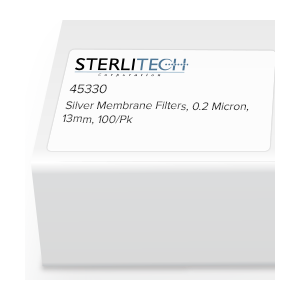
Sterlitech Silver Membrane, 0.2 Micron, 13mm, 100/Pk
Pure metallic silver (99.97% pure silver); hydrophilic, inorganic, membrane filter; pore rating of 0.2 microns and a diameter of 13 mm.
 Powered by Bioz
Specifications
General
Coefficient of Thermal Expansion: 18.8 x 10⁶ per °C
Thickness: 50 µm (1.97 mil)
Sterilization: Air, Autoclave, Steam
Resistivity: 1.59 x 10⁻⁸ Ωm at 20 °C (68 °F)
Specific Heat: 0.448 cal/g at 20 °C (68 °F)
Performance by Pore Size
| Pore Sizea | H2O Flow Rateb | Air Flow Ratec | Bubble Pointd | Max. Operating Temp.e |
|---|---|---|---|---|
| 0.2 µm | 17 | 0.35 | 13 | 204°C (400°F) |
| 0.45 µm | 40 | 0.67 | 9 | 204°C (400°F) |
| 0.8 µm | 340 | 1.4 | 7 | 204°C (400°F) |
| 1.2 µm | 460 | 2.0 | 5 | 204°C (400°F) |
| 3 µm | 690 | 2.9 | 3 | 427°C (800°F) |
| 5 µm | 870 | 5.2 | 2 | 427°C (800°F) |
a. Particle retention verified by bubble point pressure
b. Measured in mL/min/cm2 w/pre-filtered H2O at ΔP of 10 psid (0.7 bar); pre-wetted w/methanol
c. Initial flow rates measured in L/min/cm2 w/pre-filtered air at 10 psi (0.7 kg/cm2)
d. Measured using methanol
e. Silver membranes provide excellent filtration performance at temperatures up to 427°C (800°F)
Sterlitech™ Silver Membranes can be used for a wide variety of industrial hygiene, OSHA and laboratory applications.
Analytical
- X-ray diffraction (XRD); silver metal membranes make excellent substrates for XRD analysis - silver purity 99.97% -- smooth surface, grayish-white color; highly reflective surface; absolute surface retention; low background noise; distinct diffraction peaks.
- Scanning Electron Microscopy (EM); smooth; electrically conductive; extremely thin membrane 50 µm; easy sample preparation.
Gas
- Air-borne contaminants - National Institute for Occupational Safety and Health (NIOSH) - used for industrial hygiene in foundries, glass plants, quarries, mines, ceramic manufacturing - Methods using 0.45 µm, 25 mm:
- Respirable Combustible Dust (RCD) sampling and analysis - 0.8 µm, 25 mm, mines - measurement of diesel particulate matter, evaporated hydraulic fluids, fuel oils, and compressed air lubricants by weighing and ashing.
- Dopant gases for semiconductor manufacturing.
- Steam, or air sterilization, autoclavable
- Venting, high temperatures
Liquid
- Clarification (3.0-5.0 µm); Polishing (1.2 µm); Sterilization (0.2-0.8 µm)
- Intrinsically Bacteriostatic - Silver does not allow the growth of bacteria and other microorganisms.
- High-Performance Liquid Chromatography (HPLC) for a clearer; steadier baseline - may rule out interference from other sources of HPLC solvents (0.2, 0.45, and 0.8 &micor;m); tolerates high temperatures; gases and aggressive liquids -- Tetrahydrofuran (THF)
Viscous Fluid
- Organic Carbon, inorganic, and suspended-sediment water - 0.45 µm, 47 mm, used by U.S. Geological Survey (USGS)
- Lubrication oils for servomechanisms and precision instruments
- Direct-line Applications with a Sprayer
- High-purity fluids in semiconductor applications
Other Industrial
- Chlorine Monitoring - Pulp and Paper Industry, disinfection; removal of tin and zinc in iron; chlorinating hydrocarbons; manufacturing synthetic rubber, plastics, pesticides, refrigerants; treating water and sewage
- Electronics Industry - filter coolants, cleaning fluids, sterile air
- Aircraft/Missile Fuels; critical fluids - resists alcohols, fuels, hydrocarbons, polyaromatic hydrocarbons (PAH), oils, alkalies, ethers
- OSHA - coal tar pitch volatiles, 0.8 µm, 47 mm and 37 mm
- Cold Sterilization (beverages, beer) - absolute particle-retention due to precise pore size
- Soil and clay analysis
- Fly Ash Sampling; Energy Research and Development Agency (ERDA)
- Bacteria Sampling

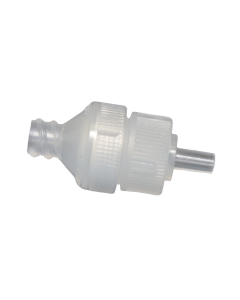
Check out other related products below!



 Frequently Asked Questions
Q: What is the shelf life of the silver membrane filters?
Silver membrane filters do not have a predetermined shelf life when stored properly. They should be kept sealed in their original packaging until use to minimize environmental exposure.
Over time, surface discoloration or silver compound formation may occur. This is largely cosmetic and does not affect pore structure, filtration efficiency, or membrane performance.
Q: What is the difference between hydrophilic and hydrophobic membrane filters?
The pores of microporous membrane filters act as small capillaries. When hydrophilic membranes come into contact with water, capillary action associated with surface tension forces causes the water to spontaneously enter and fill the pores. In this manner, the membranes are easily wetted and allow the bulk flow of water through the pores. Once wetted, hydrophilic membranes will not allow the bulk flow of air or other gasses, unless they are applied at pressures greater than the membrane’s bubble point.
Hydrophilic membrane filters are typically used with water and aqueous solutions. They can also be used with compatible non-aqueous fluids. Hydrophilic membrane filters are typically not used for air, gas or vent filtration since the filters would block flow if inadvertently wetted, by condensation for example.
When hydrophobic membranes come into contact with water, surface tension forces act to repel the water from the pores. Water will not enter the pores and the membranes will act as a barrier to water flow, unless the water is applied at pressures greater than the membrane’s water entry pressure. Low surface tension fluids, such as alcohols, can spontaneously enter and fill the pores of hydrophobic membranes. Once all the air in the pores is displaced, there are no longer any surface tension forces and water can easily enter the pores, displace the low surface tension fluid, and pass through the membrane. The membrane will then allow bulk flow of water for as long as the pore remain water filled. If the membrane is allowed to dry (i.e. air enters the pores), then it must be pre-wet with a low surface tension fluid again prior to use with water.
Hydrophobic membrane filters are typically used with compatible non-aqueous fluids. They are also commonly used as air, gas, or vent filters. Hydrophobic membrane filters are sometimes used with water or aqueous solutions; and, in these applications, they must first be prewet with a low surface tension, water miscible fluid prior to use.
Q: What does it mean if my silver membrane filter is slightly discolored?
Slight discoloration of a silver membrane filter is normal and typically cosmetic. Although silver metal membranes are made from 99.97% pure silver, they can form surface compounds over time due to environmental exposure, even when not in use.
Common silver compounds that may cause discoloration include silver sulfide (Ag₂S), silver chloride (AgCl), and other silver salts. These surface compounds do not affect pore structure, filtration efficiency, or membrane performance and are usually not a cause for concern.
To minimize discoloration, silver membrane filters should be stored in sealed packaging. In some cases, silver chloride can be removed with a brief rinse or soak in an ammonia solution, while other surface compounds may be reduced using alcohols such as methanol or ethanol.
Do not confuse discoloration with the membrane’s natural grayish-white appearance, which results from its microporous structure. Slight color differences between the two sides of the membrane are normal and are most noticeable in 3 µm and 5 µm pore sizes.
Q: Can silver membrane filters be cleaned?
Q. Can silver metal membranes be cleaned?
A. Sterlitech™ Silver Membranes: Cleaning Guidelines
Sterlitech’s Silver Metal Membrane Filters can be cleaned and reused repeatedly. The membranes should be cleaned immediately after each use, and handled carefully to avoid membrane punctures and tears. Various cleaning procedures can be used, depending on the nature, type, and degree of contamination. There are four effective cleaning methods outlined below, that can be used to clean Sterlitech’s silver metal membrane filters.
Chemical Cleaning
Immerse in a strong alkaline solution, a solvent, or an acid. Do not immerse in nitric acid, sulfuric acid, or cyanide solutions.
Ignition Cleaning
Place the silver metal membrane filter in a laboratory muffle furnace for approximately ½ hour to effectively remove organic contaminants from the membrane. Do not exceed the following temperatures.
| Retention Rating (microns) | Maximum Temperature | |
| °C | °F | |
| 5.0 | 550 | 1020 |
| 3.0 | 400 | 750 |
| 1.2 | 350 | 660 |
| 0.8 | 300 | 570 |
| 0.45 | 300 | 570 |
| 0.2 | 250 | 480 |
Combination Cleaning
A combination of chemical and ignition cleaning may be the best method to completely regenerate the membrane. Immerse in a 10 percent concentration of hydrofluoric acid for ten minutes, followed by ignition cleaning in a muffle furnace, following the guidelines given above. This can allow for reuse of membrane up to 10 times.
Ultrasonic Cleaning
Low intensity ultrasonics can be used to clean the silver metal membrane. The cleaning intensity and time will depend on the degree and type of contamination encountered. Do not use high intensity ultrasonics.
Q: What are the advantages of Silver membrane filters?
Q. What are the advantages of silver metal membranes over conventional membranes?
A. Sterlitech™ Silver Metal Membranes are 99.97% pure, thus unique in their ability to withstand extreme chemical and thermal stress, making them ideal for applications involving aggressive fluids and/or high temperatures. In addition, the purity of the membranes enables users to easily exclude and account for the few chemicals that react with silver, thus making test results and filtering operations more precise than available through traditional membranes.
Q: Can silver membrane filters be sterilized with ethylene oxide (EtO)?
Q: Can silver membrane filters be sterilized with ethylene oxide (EtO)?
A: EtO sterilization is not recommended for silver membrane filters. There is a possibility that residual acetylene in the EtO can produce explosive silver acetylide capable of detonating the EtO vapor.
Q: Can you recycle my used silver membrane filters?
We cannot recycle your filters. However, we have used Sims Recycling for many years (https://www.simslifecycle.com/) to recycle our scrap silver.
Q: What is the maximum temperature for the different filter membranes?
The maximum operating temperatures for Sterlitech filter membranes are listed below.
- Sterlitech Silver Metal - 427°C
- Sterlitech Ceramic - 350°C
- Sterlitech Polycarbonate Track Etch - 140°C
- Sterlitech Polyester - 140°C
- Sterlitech Nitrocellulose (MCE) - 130°C
- Sterlitech Nylon - 180°C
- Sterlitech Polyethersulfone (PES) - *130°C
- Sterlitech Polypropylene - 82°C
- Sterlitech Cellulose Acetate - 135°C
- Sterlitech PTFE (Laminated) - 130°C
- Sterlitech PTFE (Unlaminated) - 260°C
*5.0um and 8.0um - max temp is 180°C
Q: Do you need a Chemical Compatibility Chart?
We have a Chemical Compatibility Chart that you can use for reference.
Q: What is the difference between nominal and absolute pore size ratings?
Nominal pore size ratings provide a general indication of filter retention efficiency, meaning some particles equal to or larger than the stated pore size may pass through the filter. Nominal ratings can vary by manufacturer, so filters with the same nominal pore size may not offer equivalent filtration performance.
Absolute pore size ratings are determined through controlled particle or microbial retention testing and represent the smallest particles that are consistently retained by the membrane. These ratings are often correlated with bubble point specifications and are generally more comparable across manufacturers.
Important: Actual filtration performance depends on application conditions, even when using filters with absolute pore size ratings.
Q: What is the difference between pore size and porosity?
The pore size refers to the diameter of the individual pores in a membrane filter. Pore size is typically specified in micrometers (µm). Most membranes and filter media actually contain a distribution of pore sizes. Nominal pore size ratings typically refer to the predominant pore size of a filtration media; pores larger and smaller than the nominal rating may be present. Absolute pore size ratings typically refer to the largest pore size of a membrane and it is expected that all pores will be equal to or smaller than the absolute rating.
For the polycarbonate track-etch (PCTE) and polyester track-etch (PETE) membrane filters, porosity is the percent of the total surface area occupied by the pores; it typically ranges from <1% to 16%. For the other membrane filters, porosity is the percent of the total volume occupied by the pores; it typically ranges from 40 to 80%.
Q: How do I determine if my filter is compatible with my application?
You can find the Sterlitech compatibility guide. It is important to realize that application conditions, such as operating temperature, affect compatibility. Please contact us at [email protected] if you need assistance.
Q: What is a bubble point and how is it determined?
The bubble point is the minimum amount of pressure required to push air bubbles through the largest pore of a wet membrane. The bubble point is inversely proportional to the pore diameter, as the pore diameter decreases the bubble point increases and vice versa.
Retention efficiency of membrane filters can be directly measured by challenging the filters with suspensions of standard microorganism cultures or particles of known size. Unfortunately, such efficiency testing is necessarily destructive. However, since retention characteristics are dependent on pore size, it is possible to correlate destructive challenge testing results to non-destructive membrane bubble point tests. In this manner, the relationship between membrane pore size and membrane bubble point is empirically determined. Typically, a minimum bubble point can be determined and specified for a particular pore size rating. The bubble point specification is then used for quality control during membrane manufacture. The bubble point can also be used by the consumer as a nondestructive test to verify membrane integrity before and/or after use.
Q: What is the difference between a depth filter and membrane filter?
Depth filters are constructed with relatively thick filtration media and typically have nominal pore size ratings >1µm. Due to their large void volume, they capture significant amounts of particulate within their pore structure.
Membrane filters are typically composed of polymers that have been chemically processed, resulting in highly porous thin films with microscopic pore structures. Membrane filters typically have absolute pore size ratings <1µm, with some exceptions. Because of their very fine pore structure, membrane filters tend to trap the majority of particles on the surface. However, smaller particles with diameters near or below the pore size rating can be captured within the membrane or pass through the membrane.
Q: What's the benefit of purchasing sample packs?
Sample packs allow the customer to purchase small quantities of membrane filters at nominal cost, with various diameters and pore sizes as selected. This allows the customer to preform trials as needed to determine the optimal filter for their application before committing to purchasing standard pack quantities.
Q: Are membrane filter samples available in diameters others than 13, 25, or 47mm?
In most cases, membrane filter samples can be purchased in sizes that are not listed in the standard sample packs. Please contact us at [email protected] to inquire about availability and pricing.
Q: How can I tell the difference between the separator papers and the membrane filters?
To ensure ease of use, the membrane filters as stacked in their packaging are interleafed with layers of separator paper. In most cases, the membrane filters will be white in color except for the track-etch membranes which are colorless and translucent. In some special cases, the membranes will be dyed dark grey to black in appearance. In all cases, the separator paper will be a different color than the membrane and is usually not white. Please contact us at [email protected] if you need assistance.
Q: What filters can be used for infrared spectroscopy applications where the retained particles are analyzed while resting on the filter surface?
- Silver Membrane Filters: These are the best choice for reflectance IR spectroscopy, but cannot be used for transmission IR spectroscopy.
- Aluminum Oxide Membrane Filters: Depending on the spectral range, these are a good choice for transmission IR spectroscopy, but they are a poor choice for reflectance IR spectroscopy. These filters are extremely brittle and will fracture if subjected to bending. They cannot be handled with fingers; membrane tweezers must be used.
- Glass Microfiber Filters: Depending on the spectral range, these filters can be used for both reflectance and transmission IR spectroscopy. The paper does not specify any particular pore sizes; however, most of our offerings should have good efficiency with ≥5-micron sized particles. For good light transmission, I would guess that a thin, binder- less filter media would be best, such as Grade C or GC-50. Gold-Coated Polyester Track-Etch Filters: Gold coated polyester track-etch filters have essentially the same spectral properties as gold-coated polycarbonate track-etch filters; but they are inherently hydrophilic and, consequently, much more convenient for use with water samples. These are a good choice for reflectance IR spectroscopy, but cannot be used for transmission IR spectroscopy.
