
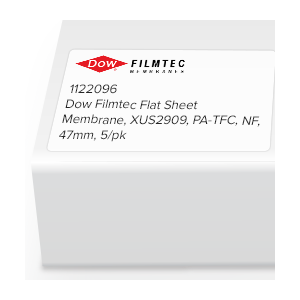
Dow Filmtec Flat Sheet Membrane, XUS2909, PA-TFC, NF, 47mm, 5/pk
 Powered by Bioz
Specifications
NF Flat-Sheet Performance Comparison by Manufacturer:
Veolia | TriSep | Synder | Microdyn Nadir
FilmTec™
| Series | XC-N | NF245 |
|---|---|---|
| Feed | Industrial Wastewater | Food / Dairy |
| Type | High Recovery | Process |
| pH Range | 2-11 | 3-10 |
| Flux (GFD)/psi | 22.9/70 | 32.0 GFD/70 psi |
| MgSO4 Rejection | 98.0% | 1.0% |
| Pore size/ MWCO | <300 | |
| Polymer | Polypiperazine | Proprietary |
Veolia
| Series | Duracid NF | DK | DL |
|---|---|---|---|
| Feed | Industrial/Commercial | Foods/Industrial | Foods/Industrial |
| Type | Acid Purification, Mineral Concentration | High Rejection | Low Energy, Low Pressure |
| pH Range | 0-9 | 2-10 | 2-10 |
| Flux (GFD)/psi | 10-19/225 | 22/100 | 28/220 |
| MgSO4 Rejection | 98.0% | 98.0% | 96.0% |
| Pore size/ MWCO | ~150-200 Da | ~150-300 Da | ~150-300 Da |
| Polymer | Proprietary | Polyamide-TFC | Polyamide-TFC |
Veolia | TriSep | Synder | Microdyn Nadir
Synder Filtration™
| Series | NDX | NFG | NFW | NFX |
|---|---|---|---|---|
| Feed | Foods/Industrial/Waste | Foods/Industrial/Waste | Foods/Industrial/Waste | Foods/Industrial/Waste |
| Type | NA | High Flux, Softening | Softening | High Rejection, Softening |
| pH Range | 4-9 | 4-10 | 4-10 | 3-10.5 |
| Flux (GFD)/psi | 35-45/110 | 65-70/110 | 50-55/110 | 30-35/110 |
| MgSO4 Rejection | 95.0% | 50.0% | 97.0% | 99.0% |
| NaCl Rejection | NA | 10.0% | 20.0% | 40.0% |
| Pore size/MWCO | ~500-700 Da | ~600-800 Da | ~300-500 Da | ~150-300 Da |
| Polymer | Polyamide-TFC | Polyamide-TFC | Polyamide-TFC | Polyamide-TFC |
Veolia | TriSep | Synder | Microdyn Nadir
TriSep™
| Series | TS40 | TS80 | SB90 | XN45 |
|---|---|---|---|---|
| Feed | Foods/Industrial/Waste | Foods/Industrial/Waste | Liquid Foods | Foods/Industrial/Waste |
| Type | Process | Softening | Chlorine Resistant | Process |
| pH Range | 2-11 | 2-11 | N/A | 2-11 |
| Flux (GFD)/psi | 20/110 | 20/110 | 30/225 | 35/110 |
| MgSO4 Rejection | 90.0% | 99.0% | 97.0% | 95.0% |
| NaCl Rejection | 40-60% | 80-90% | 85.0% | 10-30% |
| Pore size/MWCO | ~200 Da | ~150 Da | ~500 Da | |
| Polymer | Polypiperazine-amide | Polyamide-TFC | Cellulose Acetate | Polypiperazine-amide |
Veolia | TriSep | Synder | Microdyn Nadir
Microdyn Nadir™
| Series | NP010 | NP030 |
|---|---|---|
| Thickness | 210-250 µm | 210-250 µm |
| Type | Acid/Caustic Preparation, Metal, Chemical | Acid/Caustic Preparation, Metal, Chemical |
| pH Range | 0-14 | 0-14 |
| Na2SO4 Rejection | 35-75% | 80-95% |
| Processing Temp. | 5-95°C | 5-95°C |
| Polymer | PES | PES |
| Backing | PE/PP | PE/PP |
| Water Flux | >200 lmh/40 bar | >40 lmh/40 bar |
| Pore size/MWCO | ~1000 Da | ~500 Da |

Check out other related products below!

 Frequently Asked Questions
Q: I have a membrane sample that is too large to fit in my stirred cell. Can I cut it to fit?
Yes—flat sheet membranes can be cut to fit your stirred cell. For best results, use the stirred cell support disk as a template to trace the correct size, then cut the membrane carefully to match.
Q: I have a polymeric stirred cell and discovered that my disk size is not listed in the ordering information for the flat sheet membranes. Can I purchase the flat sheet membranes in the correct disk size for my stirred cell?
Q: How do I store used flat sheet crossflow membranes?
Used flat sheet crossflow membranes must be stored wet at all times. If a membrane is allowed to dry out, it can irreversibly lose water permeability and performance.
For storage, place the membrane fully submerged in one of the following solutions:
0.5% formaldehyde solution (helps prevent microbial growth)
1.0% sodium metabisulfite (SMBS) solution -- Replace the SMBS solution monthly to maintain effectiveness
UPDI water (ultrapure deionized water)--Replace the water weekly to reduce contamination and biofouling
Q: Are the flat sheet membranes available as roll stock?
Q: Why is the flat sheet membrane I'm using measuring a flux value less than the published flux value?
Flow characteristics for a spiral element and flat sheet membrane are significantly different and are really only comparable on a qualitative basis. Variability in the membrane manufacturing process, differences in water composition, test procedures, and test equipment, used in a factory, laboratory, or elsewhere, will impact water flux results.
Reference: Understanding Variation of Experimental Flux and Rejection
Q: Do you offer samples of the flat sheet cross flow membranes?
Q: What is the shelf life for the flat sheet crossflow membranes?
Sterlitech flat sheet crossflow membranes should be stored sealed in the original packaging in a climate-controlled environment, protected from direct light, heat, and temperature extremes. While we recommend using membranes as soon as practical after receipt, most flat sheet membranes can typically be stored for up to one (1) year without affecting performance when stored properly.
Q: We noticed that there are water drops in the flat sheet membrane sealed bag. Is that a quality issue?
Q: How should I remove the preservative solution from the membrane and is there any specific recommendations before use?
Q: The Flat Sheet Membranes appear dry in their packaging. How do I pre-wet them? Do I need to do this?
Q: Can I reuse flat sheet membranes after they have been removed from a test cell?
Q: I accidentally allowed my flat sheet crossflow membrane to dry out. Can I still use it?
Q: How do I clean the flat sheet membranes?
Q: Do I need to pre-condition the flat sheet membranes? And, if so, what is the recommended procedure?
Q: What is the recommended cross flow velocity (CFV) for the flat sheet membranes?
Q: How do I calculate the cross flow velocity (CFV) for flat sheet membranes?
Q: What is the recommended transmembrane pressure (TMP) for the flat sheet membranes?
Q: I have noticed that the flat sheet membranes come in sizes described as CF016, CF042, and Sepa CF. What are these sizes?
Q: What is the sodium chloride rejection for the Dow nanofiltration (NF) membranes?
For a feed solution of 2,000 ppm sodium chloride (NaCl) at 70 psi (0.5 MPa) and 77°F (25°C), the NF90 membrane has sodium chloride rejection of between 90-96% while the NF270 membrane has approximately 50% rejection.
