
SterliTECH Tip: How to Select a Spacer
· Filtration Resources

What is the purpose of spacers and shims used with the membrane test cells, and do I need them?
Crossflow velocity (CFV) refers to the linear rate of flow of the feed solution as it passes tangentially over the surface of the membrane filter and is measured in meters or feet per second. Some of the feed solution will permeate through the membrane filter, while the remaining will flow along the surface of the membrane and collect as concentrate that can be recirculated through the system. The crossflow velocity has a direct impact on the fouling rate and the occurrence of concentration polarization — where a concentration gradient forms in the fluid adjacent to the membrane surface.
Why are spacers and shims used with membrane test cells?
Shims are used in combination with spacers to simulate flow conditions typically seen in spiral wound membrane elements. Selection of shim thickness is determined by the spacer selected. Leave a small amount of headspace in the cavity after the membrane is installed for crossflow cells to operate efficiently.
Inserting feed spacers or shims into the flow channel reduces the depth of the flow channel, and consequently the cross-sectional area. Crossflow velocity is calculated by dividing the volumetric flow rate in the flow channel by the smaller cross-sectional area of the flow channel. Since feed spacers come in a wide range of thicknesses and percentage open area, the cross-sectional area is ultimately determined by the thickness of the spacer selected, and its percentage of open area.
How to calculate Cross Flow Velocity for Flat Sheet and Spiral Wound elements?
To calculate crossflow velocity (CFV), divide the volumetric flow rate of the feed solution in the flow channel by the cross-sectional area of the flow channel as shown in the equation and figure below.
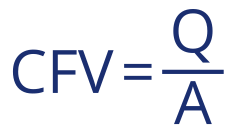
CFV = Cross Flow Velocity (m/s) Q = Flowrate (m³/s) A = Cross-sectional area (m²)
It is worth mentioning estimating cross flow velocity for spiral wound elements should be done as shown in the following study.
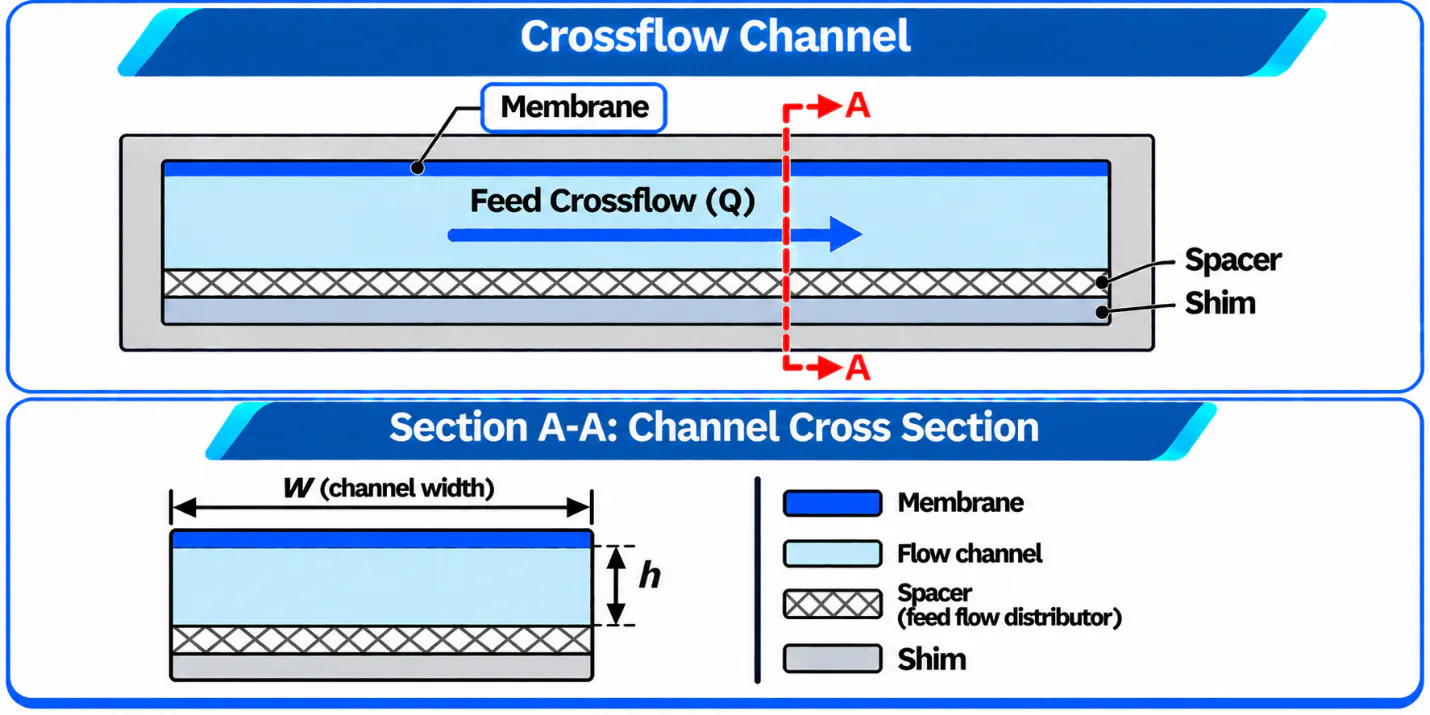
How to Select a Spacer
There are two key factors to consider when selecting feed spacers. First, the thickness of the spacer will affect clogging. A thicker spacer can accommodate more particulates and larger particles without getting clogged. Second, feed spacer thickness also affects crossflow velocity when the correct size shim is used in conjunction with the spacer, bearing in mind that there should always be a small amount of headspace in the crossflow channel.
As such, there is competing optimization. Thinner feed spacers are associated with lower crossflow velocities but are more prone to clogging. Thicker feed spacers can handle larger particulates, and more of them, with less clogging, but also have higher crossflow velocities. But this all depends on the type of flow (turbulent or laminar) which in turn is influenced by the geometry of the feed spacer as well as the crossflow velocity of the feed solution. When the flow is turbulent, the likelihood of particulates being swept away rather than accumulating on the membrane is greater. This in turn prevents concentration gradients from forming that can cause scaling.
As a rule of thumb, if particulate loads are medium to high, then thicker feed spacers will result in higher concentrate flows. If on the other hand, particulate loads are low, then thinner spacers allowing for lower concentrate flows are recommended.
The overall thickness of shim and spacer should never exceed the channel depth which can be found in the cell manual.
Ask an expert today if you have any questions about selecting shims and spacers.