
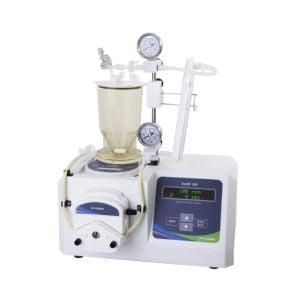
Tanfil 100, Tangential Flow Filtration System, AC100~240V, US plug
 Powered by Bioz
- Multi-purpose
- Tangential flow filtration technique enables concentration and diafiltration at same run.
- Less membrane fouling
- Feed flows parallel to membrane and thus prevents membrane fouling and increases membrane utility.
-
Tangential flow filtration(tff filtration) operates with the sample flow moving horizontally across the membrane surface at a tangential angle, preventing the accumulation of macromolecules and reducing concentration polarization caused by reduced flow rates. This ensures a stable flow rate and effectively prolongs the lifespan of the filter membrane.
- Easy scaled-up
Use same parameters and conditions from trial to mass production. - Plug & start
Integrated with pump, liquid reservoir and pressure gauges. Plug the tube, add samples and start processing.
| PERFORMANCE DATA | ||
| Max. inlet pressure | 60 psig | |
| Max. gauge pressure | 80 psig | |
| Recirculation flow rate | 0~600 mL/min | |
| Min. recirculation volume | 7 mL | |
| Reservoir | PES Reservoir, 500 mL | |
| Noise level | 55 dB | |
| Net weight | 7.8 Kg | |
| Dimension (LxWxH) | 28 x 33 x 16 cm | |
| ELECTRICAL DATA | ||
| Power input | 100-240V | |
| Frequency | 50 / 60Hz | |
| Max. Power | 50W | |
| Safety | Motor Overload Protection, Fuse | |
| OTHER DATA | ||
| Applicable capsules |
Pall, MinimateTM TFF Capsules |
|
Tanfil TFF System Certificate
- CE certification
- UKCA certification
- RoHS certification
Tanfil TFF System Application
- Concentration and desalting
- Diafiltration and purification
- Buffer exchange and dialysis
- DNA / RNA / exosomes, extracellular vesicles (EVs) concentration
- Biomolecules seperation and purication
- Desalting and buffer exchange
FAQ - Frequently Asked Questions
Here you'll find answers to our most asked questions. Still can't find quite what you're looking for, or have something we should know? Send us an email, we're happy to help!
-
Q1: What Molecular weight cutoff (MWCO) should be selected for the target molecule?
A1: The appropriate MWCO can be chosen based on the retention rate specified in the “selectivity curves” provided by capsule and cartridge manufacturers. For example, with a Pall Minimate TFF cartridge, the MWCO should be approximately 1/3 to 1/6 of the target molecule’s molecular weight. Specifically: X = average molecular weight of target molecule / MWCO of capsule = 3 to 6 (X = 3 for faster processing, X = 6 for higher retention but lower flow rate)
-
Q2: How can MWCO (kDa) be converted to nm?
A2: kDa is a unit of molecular weight, whereas nanometer (nm) is a unit of molecular size (length). They are not directly convertible but are generally correlated in a qualitative sense based on empirical relationships. We suggest choosing the appropriate unit based on the target molecule, or literature for selecting a suitable membrane.
-
Q3:Are the TFF system, capsule and cartridge sterile? How should I do if sterile condition is required?
A3: The optional Pall capsule and HansaBiomed cartridge offered by Rocker are sterile upon delivery, but the system itself is not sterile. For sterile operation, the chemical sterilization using a cleaning solution (e.g., 0.1N NaOH) is recommended to sterilize the wetted parts followed by rinsing with clean water before sample processing. Alternatively, use a 0.22um filter post-sample processing to ensure sterility.
-
Q4: What can I do if the filtration speed is too low?
A4: The filtration speed could be increased by adjusting the rotational speed or tightening the screw clamp on the retentate port, but do NOT exceed the cartridge’s maximum operating pressure. Refer to the manufacturer’s datasheet and manual for the maximum operating pressure.
-
Q5: Can the TF system. Capsule or cartridge be autoclaved?
A5: (1) TFF System Tubing (silicone, TPE), reservoir (PES), reservoir lid (PP), Luer connectors (SS316, PP, silicone), three-way valves (PC, POM), and magnetic stir bar (PTFE-coated) can be autoclaved. The main unit, magnetic stirrer, and gauge mounting set cannot be autoclaved. (2) Pall capsule and HansaBiomed cartridge: These cannot be autoclaved. Clean them according to the manufacturer’s instructions before storage. For sterile applications, refer to Question 3 for chemical sterilization. .
-
Q6: Can capsule and cartridge is reused? When should they be replaced?
A6: Capsule and cartridge can be reused if thoroughly cleaned and stored as instructed. The efficacy of capsule and cartridge can be determined by Normalized Water Permeability (NWP) testing. It’s recommended to conduct an NWP testing upon first use or after each cleaning. • Membrane Recovery Rate = NWP (after cleaning) / NWP (first use) If the recovery rate <75%, it’s recommended to clean the cartridge again. If the recovery rate <50%, it is considered to be replaced Other indicators include reduced purity due to pore size enlargement and membrane damage.
-
Q7:How should capsules and cartridges be stored?
A7:After cleaning, rinse thoroughly with sterile water before storage. Follow manufacturer's instructions for cleaning and storage. Storage Duration and Methods (A) Pall Minimate TFF Capsule <3 days: Fill with sterile water after cleaning <6 months: Fill with 0.05N ~ 0.1N NaOH solution after cleaning >6 months: Fill with 15% glycerol + 0.05% sodium azide (NaN3) solution after cleaning (B) HansaBioMed: Rinse with sterile water as last step and store in a cool, dry, ventilated place.
-
Q8:Why can’t Tanfil 100 perform continuous diafiltration?
A8:Tanfil 100 should be set up as a closed system for continuous diafiltration. Ensure the reservoir lid seals on the reservoir and connect each port on the lid with silicone tubes from the retentate port and buffer solution, and keep cap securely fastened on the rest port as shown below. *For capsule or cartridge with small pore size or low filtration speed, refer to the manual’s “continuous diafiltration for small MWCO membranes or low filtration speed” section.
-
Q9:What’s the sample processing capacity of Tanfil 100?
A9:Tanfil 100 is a lab-scale TFF system equipped with a 500ml reservoir, suitable for pre-trial testing. The processing volume varies based on sample properties, complexity, and the capsule / cartridge used. Taking Pall Minimate capsule as an example, less than 1L per batch is recommended
-
Q10:Can the TFF system be used to separate molecules of different sizes?
A10:Yes, the membrane in the capsule and cartridge can separate molecules based on size. For effective separation, the molecules should differ in size by at least 10x difference. TFF Principle: membrane pores act like a sieve, molecules smaller than the pore size through, while larger molecules are retained at the feed
-
Q11:What should be done if precipitation occurs during protein concentration?
A11:Fast concentration or over-concentration can lead to protein precipitation. Solutions include: • Reducing the rotational speed of filtration speed • Lowering the final concentration of protein • Using a capsule and cartridge with a larger MWCO to decrease concentration pressure • Using a magnetic stirrer for continuous mixing to prevent precipitation
-
Q12:Can Tanfil 100 be operated in a refrigerator lower than 4°C?
A12:Operating Tanfil 100 in a 4°C environment can cause condensation in the case, which could damage the unit. For stability or activity considerations, use ice packs or cooling mats to lower the temperature of the reservoir.
-
Q13:What are the replaceable parts for Tanfil 100? What’s the replacement frequency?
A13:In the Tanfil 100, parts included the peristaltic tube, silicone tubes, O-rings, syringe filter, and Luer connectors are consumable. The replacement frequency varies depending on operational frequency, correctness and contamination; it is generally recommended to replace these parts every 6 to 12 months
-
Q14:There’s no filtration flow or low retentate while proceeding with a Pall capsule, what could be cause?
A14:If the TFF system is set up correctly but recirculation or filtration does not occur, possible issues include: • No filtration: The membrane may contain glycerol as preservative; follow the cleaning procedure to thoroughly rinse the capsule and remove preservatives.

Check out other related products below!
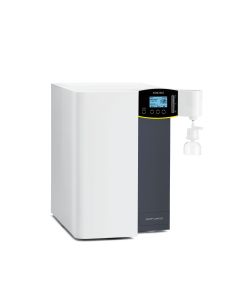
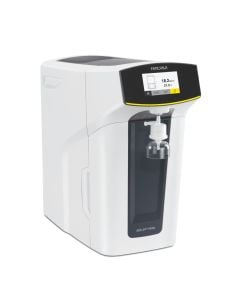


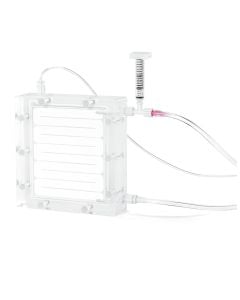
 Frequently Asked Questions
Q: What’s the best way to concentrate large sample volumes in one go?
Vivaflow® crossflow devices offer a fast, cost-effective way to concentrate 0.1–5 L samples without large-scale systems. With PES or Hydrosart® membranes and single-use or reusable options, they can achieve up to 50× concentration—1 L in ~30 min or 5 L in <75 min—with near-total recovery after a single buffer rinse.
Q: How can I reduce protein degradation during concentration?
To reduce protein degradation, optimize buffer composition and minimize shear stress—e.g., use lower centrifuge speeds for linear proteins and devices with membrane areas suited to your starting volume. Vivaflow® crossflow devices minimize shear compared to centrifugal or stirred cell systems, and diafiltration tools like the Vivaflow® reservoir help maintain optimal buffer conditions during concentration.
Q: Which ultrafiltration method is best suited for virus concentration?
For virus concentration, use a MWCO ~⅓ of the target’s molecular weight (or match pore size to diameter). For Lentivirus (~90 nm), a 300 kDa Hydrosart® membrane offers the best balance of speed and recovery, with 100 kDa PES as a slower alternative. Always validate device, membrane, and MWCO for your specific virus.
Q: How can I maximize my protein concentration and protein recovery?
To maximize protein concentration and recovery, match your membrane, MWCO, and device to your protein type. Consider sample properties, membrane material (PES, RC, CTA, HY), and choose a MWCO ~⅓ of target size. Optimize device design, pre-treat to reduce non-specific binding, and use dead-stop pockets or pre-filled filtrate tubes for maximum sample retrieval.
