
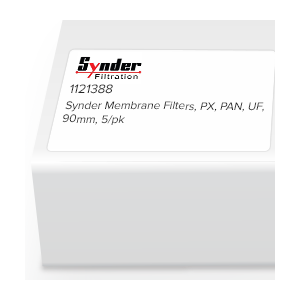
Synder Membrane Filters, PX, PAN, UF, 90mm, 5/pk
 Powered by Bioz
Specifications
UF Flat-Sheet Performance Comparison by Manufacturer:
Veolia | TriSep | Synder | Microdyn Nadir
Veolia
| Series | GE | GH | GK | PT | PW | MW |
|---|---|---|---|---|---|---|
| Feed | Surface/Chemical | Surface/Chemical | Surface/Chemical | Process/Ultrapure | Process/Ultrapure | Oil/Water |
| Type | Pre-Treatment, Color Reduction, Purification | Pre-Treatment, Color Reduction, Purification | Pre-Treatment, Color Reduction, Purification | Pre/Post Treatment | Pre/Post Treatment | Hydrophilic |
| pH Range (25 °C) | 1-11 | 1-11 | 1-11 | 1-11 | 1-11 | 2-9 |
| Flux (GFD)/psi | 18/400 | 20/150 | 17/75 | 90/50 | 85/30 | 176/20 |
| Rejection Size | 1K-PEG | 2K-PEG | 3K-PEG | 5K-Dextran | 10K-Dextran | 50K-Protein |
| Pore Size/ MWCO | 1,000 Da | 2,000 Da | 3,000 Da | 5,000 Da | 20,000 Da | 50,000 Da |
| Polymer | Composite Polyamide | Polyamide-TFC | Polyamide-TFC | Polyethersulfone | Polyethersulfone | PAN |
Veolia | TriSep | Synder | Microdyn Nadir
Synder Filtration™
| Series | VT | MT | ST | SM | MK | V3 | BN | MQ | MQ MAX | V4 | BY | LY | V5 | BX | LX | A6 | V6 | V7 |
|---|---|---|---|---|---|---|---|---|---|---|---|---|---|---|---|---|---|---|
| Feed1 | IND | IND | IND | IND/WW | IND | IND/WW | IND | IND | IND | IND/WW | IND | IND | IND/WW | IND | IND | IND | IND/WW | IND/WW |
| Type2 | AB, Pharma | Protein, Enzyme | BC | BC, DC | DC | Alkalines | Brine, Protein | Protein, BC | Protein, BC | FR | CWM, Particle | CWM, Particle | FR | CWM, Particle | CWM, Particle | AP, Microbial | CP | Laundry Waste |
| pH Range3 | 1-11 | 1-11 | 1-11 | 2-11 | 1-11 | 1-11 | 1-11 | 1-10 | 1-13 | 1-11 | 1-11 | 1-11 | 1-11 | 1-11 | 1-11 | 1-11 | 1-11 | 1-11 |
| Flux (GFD)/psi | 81-125/60 | 133-205/60 | 146-225/60 | 166-255/60 | 169-260/60 | 143-220/60 | 156-240/60 | 176-270/60 | 176-270/60 | 163-250/60 | 228-350/60 | 195-300/60 | 228-350/60 | 244-375/60 | 228-350/60 | 254-390/60 | 241-370/60 | 325-500/60 |
| Rej. Size | 3K | 5K | 10K | 20k | 30K | 30K | 50K | 50K | 50K | 70K | 100K | 100K | 200K | 250K | 300K | 500K | 500K | 800K |
| Pore size/ MWCO | 3,000 Da | 5,000 Da | 10,000 Da | 20,000 Da | 30,000 Da | 30,000 Da | 50,000 Da | 50,000 Da | 50,000 Da | 70,000 Da | 100,000 Da | 100,000 Da | 200,000 Da | 250,000 Da | 300,000 Da | 500,000 Da | 500,000 Da | 800,000 Da |
| Polymer | PES | PES | PES | PES | PES | PVDF+ | PVDF | PES | PES | PVDF+ | PVDF | PES | PVDF+ | PVDF | PES | PVDF | PVDF+ | PVDF+ |
Notes:
1 IND=Industrial; WW=Waste Water
2 AB=Antibiotics; AP=Aniodic Paint; BC=Beverage Clarification; CP=Cathiodic Paint; CWM=Corn Wet Milling; DC=Dairy Clarification; FR=Fouling Resistant
3 Evaluated at 25 °C
| Series | LV | PX | PY | PZ |
|---|---|---|---|---|
| Feed | Industrial | Wastewater | Wastewater | Wastewater |
| Type | Corn Wet Milling | Oil Removal | Oil Removal, Enzyme Processing |
Oil Removal, Enzyme Processing |
| pH Range (25 °C) | 2-10 | 3-10 | 2-11 | 3-10 |
| Flux (GFD)/psi |
202-310/60 |
244-375/60 | 192-295/60 | 179-275/60 |
| Rejection Size | 200K | 300K | 100K | 30K |
| Pore Size/ MWCO | 200,000 Da | 300,000 Da | 100,000 Da | 30,000 Da |
| Polymer | PES | PAN | PAN | PAN |
Veolia | TriSep | Synder | Microdyn Nadir
TriSep™
| Series | UA60 | UF5 | UF10 | UE50 | UB70 |
|---|---|---|---|---|---|
| Feed | Process | Process | Process | Process | Dairy/Wastewater |
| Type | "Tight" | Protein Concentration (High Solids) | Purification, Protein | "Open" | Industrial Wastewater |
| pH Range (25 °C) | 2-11 | 2-11 | 2-11 | 2-11 | 2-11 |
| Flux (GFD)/psi | 45-80/110 | 10/30 | 60/20 | 240/20 | 48/3 |
| Rejection Size | 80% MgSO4 | - | 95% Cytochrome-C | 90% Dextran | - |
| Pore Size/ MWCO | 1,000 Da | 5,000 Da | 10,000 Da | 100,000 Da | 0.03 µm |
| Polymer | Polypiperazine-amide | Polyethersulfone | Polyethersulfone | Polyethersulfone | Polyvinylidene Fluoride |
Veolia | TriSep | Synder | Microdyn Nadir
Microdyn Nadir™
| UH004 | UP005 | UP010 | UP020 | UH030 | UH050 | UP150 | UC500 | UV150 | |
|---|---|---|---|---|---|---|---|---|---|
| Feed | Environment, metal, textile, paper, food, pharma/biotech, chemical | Environment, metal, textile, paper, food, pharma/biotech, chemical | Environment, metal, textile, paper, food, pharma/biotech, chemical | Environment, metal, textile, paper, food, pharma/biotech, chemical | Environment, metal, textile, paper, food, pharma/biotech, chemical | Environment, metal, textile, paper, food, pharma/biotech, chemical | Environment, metal, textile, paper, food, pharma/biotech, chemical | Environment, metal, paint, paper, pharma/biotech | Environment, metal, paint, paper, pharma/biotech |
| Type | Hydrophilic, high chemical resistance |
Hydrophilic, high chemical resistance |
Hydrophilic, high chemical resistance |
Hydrophilic, high chemical resistance |
Hydrophilic, high chemical resistance |
Hydrophilic, high chemical resistance |
Hydrophilic, high chemical resistance |
Extremely hydrophilic | High stability against oxidizing agents |
| pH Range (25 °C) | 0 to 14 | 0 to 14 | 0 to 14 | 0 to 14 | 0 to 14 | 0 to 14 | 0 to 14 | 1 to 11 | 2 to 11 |
| Flux (GFP/psi) | 17/58 | 23.2/58 | 116/58 | 163/58 | 81.2/58 | 197/58 | 336/29 | 203/29 | 336/29 |
| Rejection Size | N/A | N/A | N/A | N/A | N/A | N/A | N/A | N/A | N/A |
| Pore Size/ MWCO | 4,000 Da | 5,000 Da | 10,000 Da | 20,000 Da | 30,000 Da | 50,000 Da | 150,000 Da | 500,000 Da | 150,000 Da |
| Polymer | PESH | PES | PES | PES | PESH | PESH | PES | RC | PVDF |
| Max Temp © | 95 | 95 | 95 | 95 | 95 | 95 | 95 | 55 | 95 |
Veolia | TriSep | Synder | Microdyn Nadir

Check out other related products below!

 Frequently Asked Questions
Q: I have a membrane sample that is too large to fit in my stirred cell. Can I cut it to fit?
Yes—flat sheet membranes can be cut to fit your stirred cell. For best results, use the stirred cell support disk as a template to trace the correct size, then cut the membrane carefully to match.
Q: I have a polymeric stirred cell and discovered that my disk size is not listed in the ordering information for the flat sheet membranes. Can I purchase the flat sheet membranes in the correct disk size for my stirred cell?
Q: What's the difference between Synder PVDF and PVDF+ Membranes?
We offer both BN and V3 Ultrafiltration Flat Sheet Membranes from Synder. The BN is composed of a standard polyvinylidene fluoride material (PVDF), while V3 iscomposed of material designated as PVDF+. This membrane has been treated to create a positive surface charge, optimizing it for alkaline cleaner and industrial waste water treatment applications.
Q: How do I store used flat sheet crossflow membranes?
Used flat sheet crossflow membranes must be stored wet at all times. If a membrane is allowed to dry out, it can irreversibly lose water permeability and performance.
For storage, place the membrane fully submerged in one of the following solutions:
0.5% formaldehyde solution (helps prevent microbial growth)
1.0% sodium metabisulfite (SMBS) solution -- Replace the SMBS solution monthly to maintain effectiveness
UPDI water (ultrapure deionized water)--Replace the water weekly to reduce contamination and biofouling
Q: Are the flat sheet membranes available as roll stock?
Q: Why is the flat sheet membrane I'm using measuring a flux value less than the published flux value?
Flow characteristics for a spiral element and flat sheet membrane are significantly different and are really only comparable on a qualitative basis. Variability in the membrane manufacturing process, differences in water composition, test procedures, and test equipment, used in a factory, laboratory, or elsewhere, will impact water flux results.
Reference: Understanding Variation of Experimental Flux and Rejection
Q: Do you offer samples of the flat sheet cross flow membranes?
Q: What is the shelf life for the flat sheet crossflow membranes?
Sterlitech flat sheet crossflow membranes should be stored sealed in the original packaging in a climate-controlled environment, protected from direct light, heat, and temperature extremes. While we recommend using membranes as soon as practical after receipt, most flat sheet membranes can typically be stored for up to one (1) year without affecting performance when stored properly.
Q: We noticed that there are water drops in the flat sheet membrane sealed bag. Is that a quality issue?
Q: How should I remove the preservative solution from the membrane and is there any specific recommendations before use?
Q: The Flat Sheet Membranes appear dry in their packaging. How do I pre-wet them? Do I need to do this?
Q: Can I reuse flat sheet membranes after they have been removed from a test cell?
Q: I accidentally allowed my flat sheet crossflow membrane to dry out. Can I still use it?
Q: How do I clean the flat sheet membranes?
Q: Do I need to pre-condition the flat sheet membranes? And, if so, what is the recommended procedure?
Q: What is the recommended cross flow velocity (CFV) for the flat sheet membranes?
Q: How do I calculate the cross flow velocity (CFV) for flat sheet membranes?
Q: What is the recommended transmembrane pressure (TMP) for the flat sheet membranes?
Q: I have noticed that the flat sheet membranes come in sizes described as CF016, CF042, and Sepa CF. What are these sizes?
Q: Do you offer cellulose acetate ultrafiltration (UF) flat sheet membranes?
Currently we do not offer cellulose acetate UF flat sheet membranes. However, we do offer a wide variety of hydrophilic flat sheet UF membranes that may be considered as alternatives.
Q: I want to separate a large molecule of known molecular weight from an aqueous solution. Which ultrafiltration (UF) membrane would I select?
In general, retention of large molecules is not only influence by the molecular weight of the molecule, but also by the shape of the molecule and the physiochemical interactions between the molecule and the membrane. For greatest retention, you should select a UF membrane that has a molecular weight cut-off (MWCO) rating equal to or smaller than the molecular weight of the target molecule.
You may also want to evaluate a UF membrane with a MWCO rating that is one step larger than the target molecule. You may find that this selection offers advantages of lower operating pressure and/or higher permeate flux while still exhibiting acceptable retention of the target molecule.
You can find Sterlitech’s offering of flat sheet UF membranes at https://www.sterlitech.com/ultrafiltration-uf-membrane.html. Please click on the “Application/Specification” tab near the middle of the page, and scroll down as necessary, to review the MWCO ratings.
Q: What is the difference between Microdyne Nadir polyethersulfone (PES) ultrafiltration (UF) membranes and hydrophilic polyethersulfone (PESH) UF membranes?
Both the Microdyne Nadir PES UF membranes and the PESH UF membranes are composed of polyethersulfone and are hydrophilic. The PESH UF membranes have been modified for enhanced hydrophilic properties and, consequently, may be more easily preconditioned and may have better resistance to fouling in some applications.
