
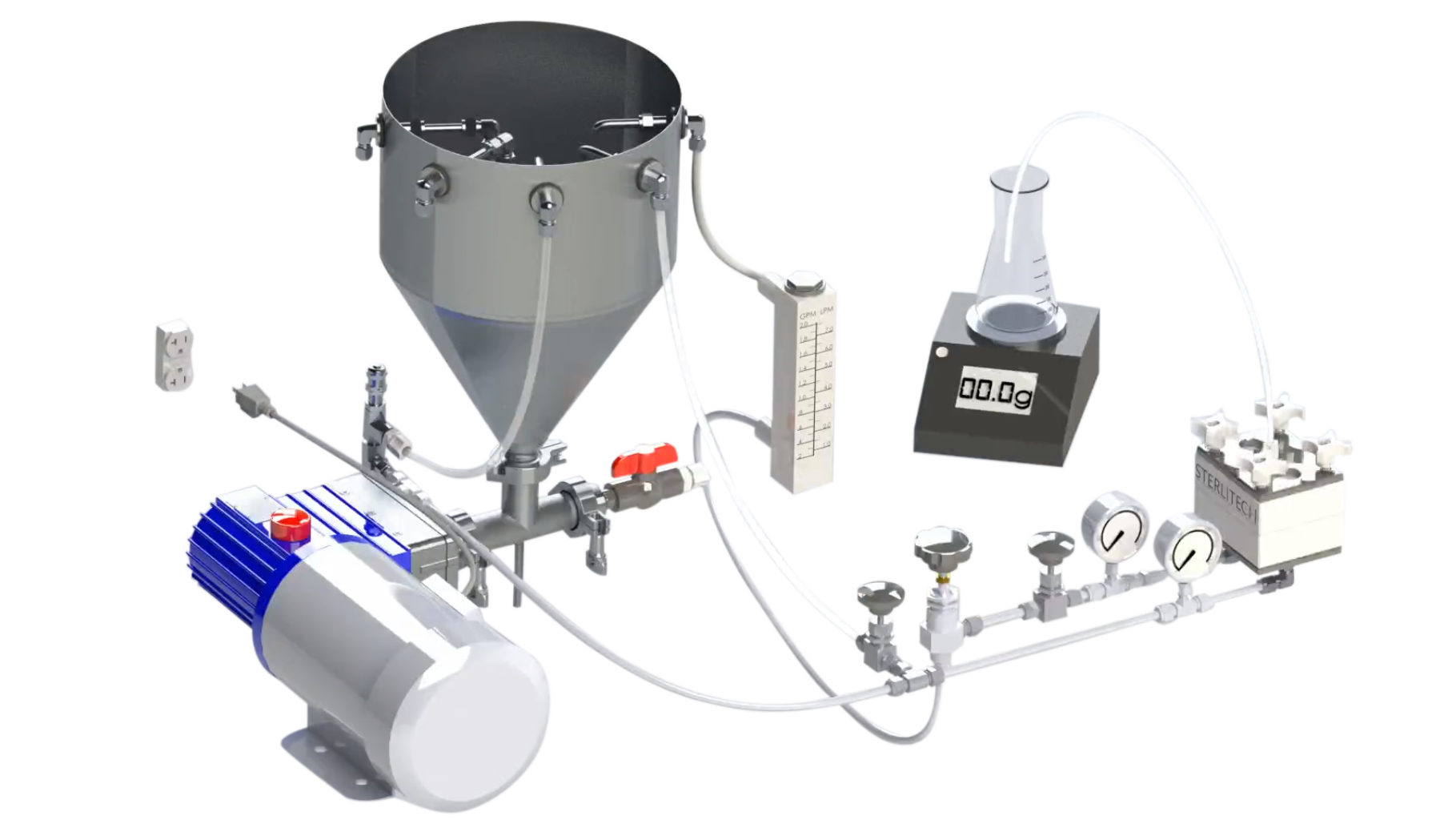
Sterlitech offers do-it-yourself (DIY) kits for operating our Membrane Test Cells as well as fully assembled systems.
The kits require assembly and do NOT include:
1) Wiring of the pump/motor and VFD
2) A main power switch
3) Membrane test cells
4) System mounting
5) Premade NPT and compression fitting connections between component assemblies
6) Scale and permeate collector
Interested in learning how to operate our membrane process equipment? Check out our MPD channel to watch videos now!
| SKU | Product Name | Est Ship | Price | ||
|---|---|---|---|---|---|

|
1200397 | Explorer Cross/Tangential Flow Kit, 110V, 60Hz, 1Ph | 5-7 days |
$15,133.00
|
|

|
1200469 | Explorer Cross/Tangential Flow Kit, 230V, 50/60Hz, 1Ph | 5-7 days |
$15,133.00
|
|

|
1200398 | Developer Cross/Tangential Flow Kit (includes cell), 110V, 60Hz, 1Ph | 5-7 days |
$22,802.27
|
|

|
1200484 | Developer Cross/Tangential Flow Kit (includes cell), 230V, 50/60Hz, 1Ph | 5-7 days |
$22,802.27
|
|

|
1200485 | Entrepreneur Cross/Tangential Flow Kit, 110V, 60Hz, 1Ph | 5-7 days |
$16,775.45
|
|

|
1200486 | Entrepreneur Cross/Tangential Flow Kit, 230V, 50/60Hz, 1Ph | 5-7 days |
$16,775.45
|
|

|
1200456 | Developer Cross/Tangential Flow Kit (includes cell), Ultra High Pressure, 230V, 50/60Hz, 1Ph | Contact Us |
$30,125.18
|
|

|
1160318 | Explorer Cross/Tangential Flow Kit, Low Pressure, 110V, 60Hz, 1Ph | 5-7 days |
$6,935.99
|
|

|
1160393 | Explorer Cross/Tangential Flow Kit, Low Pressure, 230V, 50/60Hz, 1Ph | 5-7 days |
$6,935.99
|
|

|
1200160 | Skid System Hold-up Volume Recovery Kit, 110V/60Hz | 5-7 days |
$695.06
|
Accessory
 Frequently Asked Questions
Q: Why is the flat sheet membrane I'm using measuring a flux value less than the published flux value?
Flow characteristics for a spiral element and flat sheet membrane are significantly different and are really only comparable on a qualitative basis. Variability in the membrane manufacturing process, differences in water composition, test procedures, and test equipment, used in a factory, laboratory, or elsewhere, will impact water flux results.
Reference: Understanding Variation of Experimental Flux and Rejection
Q: What is the recommended flow rate for the CF cells?
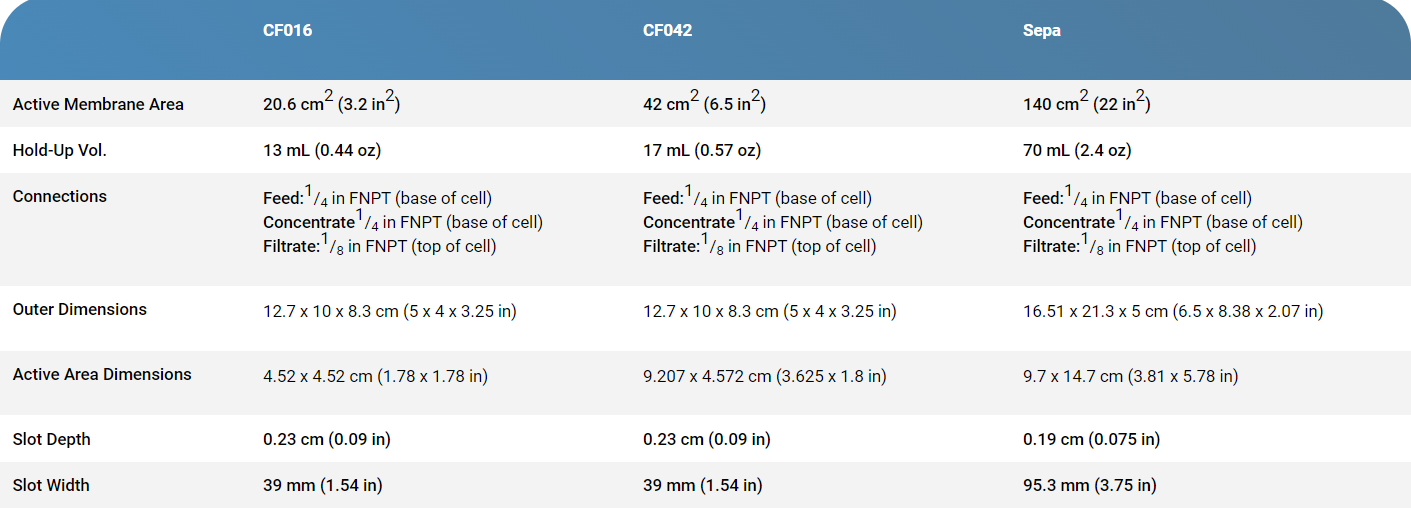
lease refer to the following diagram to examine recommended feed flow rates for the crossflow cell you are working with.
Q: What is the application of feed spacer?
Feed spacers are used to mimic the hydrodynamic conditions of large-scale membrane modules by changing the flow regime and creating turbulence inside the feed channel of our membrane test cells.
For more information on feed spacers incorporated into our test cells, please visit here.
Q: What is the thickness of feed spacers (17, 31, 47, and 65 mil diamond spacers)?
The “mil” measurement represents 1/1000th of an inch. Therefore, the thicknesses are 0.017, 0.031, 0.047, 0.065 inches (17, 31, 47, and 65 mil, accordingly).
Q: What is the application of permeate carriers?
Permeate carriers, also known as “permeate water carriers” are aids that are installed between two layers of the flat sheet membranes in a spiral wound element. The main application of this collection layer is to prevent the membrane layers from closing in on each other under high-pressure operations and also facilitate the collection of permeate water.
Q: What are the available materials of construction for the Sterlitech crossflow test cells?
The Sterlitech bench-scale crossflow test cells are available in a variety of materials to suit most applications:
- Stainless Steel
- PTFE
- HastelloyTM
- Delrin (natural acetal copolymer)
- Acrylic
Addtionally, there are a variety of available o-ring seals including Buna-N, EPDM, Viton, FEP encapsulated Viton, and FFKM (Markez).
Q: Can I reuse flat sheet membranes after they have been removed from a crossflow test cell?
Yes, you may attempt to reuse flat sheet membranes. However, you may find it difficult to achieve a leak free seal. The cell body o-rings necessarily compress the membrane during installation and the physical action of separating the membrane from the o-rings during removal may cause damage. This damage can impede that ability to achieve a leak free seal when the membrane is reused.
Q: How do I install/remove permeate fittings or other plastic NPT fittings?
Sterlitech recommends to install all plastic fittings by hand using PTFE tape. If a plastic NPT or compression fitting starts to leak during operational testing, tighten the fitting carefully until the leaking stops. Excessive tightening may break the fitting or damage other components.
If the fittings is broken and stuck in the cell top, use a spiral flute extractor bit or similar tool to release the portion of the fitting in the cell top. If the cell top becomes cracked from removal efforts, a replacement can be purchased.
Q: What are the differences between the crossflow test cells and the Sterlitech HP4750 stirred cell?
Sterlitech crossflow test cells (Sepa® CF, CF042, and CF016) operate in true crossflow filtration mode, meaning the feed flows tangentially across the membrane and produces both a permeate stream and a concentrate (retentate) stream. These systems allow continuous operation, with user-controlled pressure and crossflow rate, and enable ongoing sampling from both streams during testing.
The HP4750 Stirred Cell, by comparison, is a sealed batch filtration device (up to 300 mL feed volume) typically pressurized with compressed gas. It runs in normal-flow (dead-end) mode and does not have a concentrate stream. A stir bar helps reduce concentration polarization and simulates crossflow-like mixing at the membrane surface, but it is not true crossflow.
Q: What is the application of shims?
During high-pressure filtration processes, the membrane sheet inside the cell may deflect outwards into the feed channel. This occurs due to variations in pressure during operation. This movement can cause rubbing against O-rings which can result in abrasion, possibility rupture, in the membrane sheet. Therefore, a piece of material (shim) can also be placed between the membrane layer and the test cell to take up the free space and help to prevent movement.
For more information on shims incorporated into our test cells, please visit here.
