
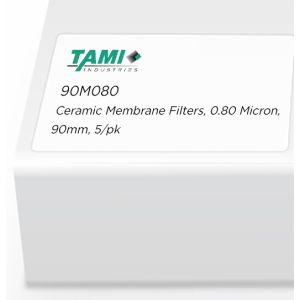
TAMI Ceramic Membrane, 0.8 Micron, 90mm, 5/Pk
 Powered by Bioz
General
| Sterilization | EtO, Autoclave |
| Thickness | 2.5 mm |
| Max. Pressure | 4 bar (58 psi) |
| Max. Operating Temp | 350 °C (662 °F) |
Performance by Pore Size
| Designation1 | pH Range | Active Layer | |
|---|---|---|---|
| 1 kDa | Fine UF | 2-14 | TiO2 |
| 3 kDa | Fine UF | 2-14 | TiO2 |
| 5 kDa | Fine UF | 2-14 | TiO2 |
| 8 kDa | Fine UF | 2-14 | TiO2 |
| 15 kDa | UF | 0-14 | ZrO2 |
| 50 kDa | UF | 0-14 | ZrO2 |
| 150 kDa | UF | 0-14 | ZrO2 |
| 300 kDa | UF | 0-14 | ZrO2 |
| 0.14 µm | MF | 0-14 | ZrO2-TiO2 |
| 0.20 µm | MF | 0-14 | ZrO2-TiO2 |
| 0.45 µm | MF | 0-14 | ZrO2-TiO2 |
| 0.80 µm | MF | 0-14 | ZrO2-TiO2 |
| 1.40 µm | MF | 0-14 | ZrO2-TiO2 |
*Notes:
1 Fine UF membranes are shipped dry, but must be stored wet after first use. Sterlitech recommends using a solution of 1% sodium metabilsulfite in ultrapure water and storing the wetted membranes in a zip-closure bag to prevent growth of microorganisms.
Applications
- Sterile concentrations
- Purification of cells, yeast, proteins, bacteria, serums, broth or enzymes
- General separations
- Fine UF, UF, and MF processes
Ceramic Membrane Cleaning Guidelines

Check out other related products below!


 Frequently Asked Questions
Q: What are the advantages of Ceramic membrane filters?
Ceramic membrane filters are manufactured from a robust inorganic matrix of zirconium oxide and titanium dioxide, providing exceptional mechanical strength, chemical resistance, and thermal stability. These inert ceramic filtration membranes can operate at temperatures up to 350 °C, far exceeding the limits of conventional polymer membrane filters.
Thanks to their superior resistance to aggressive chemicals, solvents, and extreme pH conditions, ceramic membranes are ideally suited for demanding filtration applications. Their durability allows for repeated regeneration, backflushing, and high-temperature or chemical cleaning without loss of performance.
These advantages make ceramic membrane filters well suited for industrial filtration, pharmaceutical processing, biotechnology, food and beverage applications, and other processes requiring long service life, consistent performance, and high-temperature operation.
Q: What is the recommended method for preconditioning a tubular ceramic membrane?
According to CeraMem, the manufacturer of Kleansep and Micro-Kleansep membranes, the membranes can be cleaned before use with soft water containing 200 ppm NaOCl, at pH 10 and 50°C, for 20 minutes.
Q: What is the maximum temperature for the different filter membranes?
The maximum operating temperatures for Sterlitech filter membranes are listed below.
- Sterlitech Silver Metal - 427°C
- Sterlitech Ceramic - 350°C
- Sterlitech Polycarbonate Track Etch - 140°C
- Sterlitech Polyester - 140°C
- Sterlitech Nitrocellulose (MCE) - 130°C
- Sterlitech Nylon - 180°C
- Sterlitech Polyethersulfone (PES) - *130°C
- Sterlitech Polypropylene - 82°C
- Sterlitech Cellulose Acetate - 135°C
- Sterlitech PTFE (Laminated) - 130°C
- Sterlitech PTFE (Unlaminated) - 260°C
*5.0um and 8.0um - max temp is 180°C
Q: What is the proper orientation for a ceramic membrane disc filter?
Ceramic membranes have two noticeably different sides. One is bright white and very smooth, while the other is off-white and somewhat rougher. The off-white/tan side also will have text printed on it, which specified the lot number and pore size of the membrane.
Proper orientation of the ceramic membrane disc filters is critical to their performance. The disc should always be oriented so that the white smooth membrane surface is facing toward the feed.
Q: Does Sterlitech offer ceramic membrane filters rated for reverse osmosis?
The ceramic membrane filters are only available with microfiltration and ultrafiltration retention characteristics. It is not within the capability of current technology to manufacture ceramic membranes with the salt rejection characteristics required for NF and RO applications.
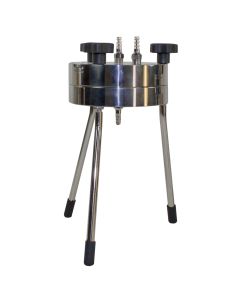
Q: What type of holder is suggested for use with the ceramic membrane disk filters?
The ceramic membrane disk filters are considerably thicker than conventional membrane disk filters and will not fit in conventional disk filter holders. The ceramic membrane disk filters must be used with the specially designed holders offered here.
Q: Are Sterlitech ceramic membrane disk filters available with diameters other than 47mm and 90mm?
The ceramic membrane filters are only available with 47mm and 90mm diameters. You may want to consider other inorganic membranes, such as alumina oxide or silver, for applications requiring different diameters.
Q: How do I determine if my filter is compatible with my application?
You can find the Sterlitech compatibility guide. It is important to realize that application conditions, such as operating temperature, affect compatibility. Please contact us at [email protected] if you need assistance.
Q: How can I convert from a pore size rating in microns to molecular weight cutoff (MWCO) in Daltons?
There is no direct conversion between microns, a unit of length, and Daltons, a unit of molecular weight. However, there is an approximate correlation between pore size rating and MWCO. However, the following chart can be consulted to know what MWCO might fit best based on the pore structure of the membranes.
