
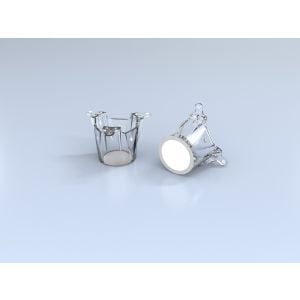
cellQART 12-Well Cell Culture Insert PET, 8.0um, Translucent, 48/pk
 Powered by Bioz
Features & Specifications
- Ease of use by convenient pipette access (patented design since 2011)
- Optimized gas exchange by product design
- Compatible to standard well-plates
- Industry leading quality standards to ensure membrane parameter consistency (important for consistent cell culture results)
- RNase/DNase Free and Non-pyrogenic
- DIN EN ISO 9001 and DIN EN ISO 13485 certified


| Growth Area | Membrane Optics | Pore Size | Pore Density per cm2 | Membrane Thickness | Quantity per box | |
| 6-Well Insert PET | 4.5 cm2 | Translucent | 0.4 µm | 100 x 106 | 11.5 ± 2.0 µm | 48 Inserts |
| 1.0 µm | 2 x 10⁶ | 11.0 ± 2.0 µm | ||||
| 3.0 µm | 2 x 10⁶ | 9.0 ± 2.0 µm | ||||
| 5.0 µm | 0.6 x 10⁶ | 10.5 ± 2.5 µm | ||||
| 8.0 µm | 0.2 x 10⁶ | 12.5 ± 3.0 µm | ||||
| Clear Extended Culture | 0.4 µm | 4 x 10⁶ | 11.5 ± 2.0 µm | |||
| Clear | 0.4 µm | 2 x 10⁶ | 11.5 ± 2.0 µm | |||
| 1.0 µm | 2 x 10⁶ | 11.0 ± 2.0 µm | ||||
| 3.0 µm | 0.6 x 10⁶ | 9.0 ± 2.0 µm | ||||
| 5.0 µm | 0.6 x 10⁶ | 10.5 ± 2.5 µm | ||||
| 8.0 µm | 0.1 x 10⁶ | 12.5 ± 3.0 µm | ||||
| 12-Well Insert PET | 1.1 cm2 | Translucent | 0.4 µm | 100 x 106 | 11.5 ± 2.0 µm | 48 Inserts |
| 1.0 µm | 2 x 10⁶ | 11.0 ± 2.0 µm | ||||
| 3.0 µm | 2 x 10⁶ | 9.0 ± 2.0 µm | ||||
| 5.0 µm | 0.6 x 10⁶ | 10.5 ± 2.5 µm | ||||
| 8.0 µm | 0.2 x 10⁶ | 12.5 ± 3.0 µm | ||||
| Clear Extended Culture | 0.4 µm | 4 x 10⁶ | 11.5 ± 2.0 µm | |||
| Clear | 0.4 µm | 2 x 10⁶ | 11.5 ± 2.0 µm | |||
| 1.0 µm | 2 x 10⁶ | 11.0 ± 2.0 µm | ||||
| 3.0 µm | 0.6 x 10⁶ | 9.0 ± 2.0 µm | ||||
| 5.0 µm | 0.6 x 10⁶ | 10.5 ± 2.5 µm | ||||
| 8.0 µm | 0.1 x 10⁶ | 12.5 ± 3.0 µm | ||||
| 24-Well Insert PET | 0.3 cm2 | Translucent | 0.4 µm | 100 x 106 | 11.5 ± 2.0 µm | 48 Inserts |
| 1.0 µm | 2 x 10⁶ | 11.0 ± 2.0 µm | ||||
| 3.0 µm | 2 x 10⁶ | 9.0 ± 2.0 µm | ||||
| 5.0 µm | 0.6 x 10⁶ | 10.5 ± 2.5 µm | ||||
| 8.0 µm | 0.2 x 10⁶ | 12.5 ± 3.0 µm | ||||
| Clear Extended Culture | 0.4 µm | 4 x 10⁶ | 11.5 ± 2.0 µm | |||
| Clear | 0.4 µm | 2 x 10⁶ | 11.5 ± 2.0 µm | |||
| 1.0 µm | 2 x 10⁶ | 11.0 ± 2.0 µm | ||||
| 3.0 µm | 0.6 x 10⁶ | 9.0 ± 2.0 µm | ||||
| 5.0 µm | 0.6 x 10⁶ | 10.5 ± 2.5 µm | ||||
| 8.0 µm | 0.1 x 10⁶ | 12.5 ± 3.0 µm |
Cell Culture Insert Membrane Pore Size by Application

Check out other related products below!
 Frequently Asked Questions
Q: Are the cellQART Cell Culture Inserts supplied with well plates?
Yes. cellQART Cell Culture Inserts are available pre-loaded in compatible well plates for convenient, ready-to-use cell culture workflows. Visit https://www.sterlitech.com/cellqart-pre-loaded-in-well-plates.html to view available plate formats and configurations.
Q: Is there a bibliography for cellQART®?
Yes, there is. You can view the bibliography for cellQART® here.
Q: I occasionally have a leak and will lose media. Sometimes there is ring of cells absent at the interface of the insert and the bottom of the well.
Try an insert with a lower pore density with clear membrane optics and optimize seeding density.
Q: I am currently using polycarbonate membrane inserts and want to switch to cellQART, how will that affect my cells?
cellQART cell culture inserts feature a polyester (polyethylene terephthalate, PET) track-etched membrane rather than a polycarbonate membrane. Differences in membrane chemistry, surface energy, and pore architecture can impact cell attachment, proliferation, morphology, and differentiation. When transitioning from polycarbonate to PET membranes, variations in extracellular matrix adsorption and cell–substrate interactions may alter growth behavior.
To ensure optimal performance in cell culture, transwell assays, and in vitro permeability or migration studies, Sterlitech recommends performing seeding density optimization by testing both increased and decreased cell concentrations relative to your current protocol. This approach allows users to identify conditions that support improved confluence, barrier integrity, and reproducibility when using Sterlitech cellQART membrane inserts.
Q: Does the transparency of the membrane affect my results?
Yes. Membrane transparency can directly influence imaging quality and experimental monitoring in cell culture applications. Sterlitech’s transparent cellQART® track-etched membranes are optimized for phase contrast microscopy, live-cell imaging, and real-time monitoring of cell morphology and confluence. Improved optical clarity enables clearer visualization of cells without membrane interference, supporting more accurate assessment during transwell assays, co-culture systems, and permeability studies.
Q: We use fluorescence microscopy. Should we use transparent or translucent inserts?
Both transparent and translucent cell culture inserts are suitable for fluorescence microscopy and fluorescent imaging applications. Each membrane type allows sufficient light transmission for fluorescent analysis, making them compatible with common fluorescence microscopes.
Transparent membranes are ideal when maximum optical clarity is desired, such as for high-resolution imaging, cell visualization, or detailed morphology studies.
Translucent membranes are also fully compatible with fluorescence microscopy and are frequently used in routine fluorescent assays, permeability studies, and transport experiments.
Ultimately, the choice between transparent or translucent inserts depends on your imaging resolution requirements, experimental design, and personal preference, rather than limitations in fluorescence compatibility.
Q: We need a certain level of transparency. Will that influence insert porosity?
Transparency increases as porosity decreases, so porosity requirements will impact transparency.
Q: Are cellQART Cell Culture Inserts compatible with standard well plates?
Yes. cellQART Cell Culture Inserts are designed to be fully compatible with standard 6-well, 12-well, and 24-well plates. Their patented hanging design ensures accurate positioning within the well while maintaining excellent pipetting access for routine cell culture handling.
Q: We’d like better initial cell attachment, is there something we can do?
Prior to seeding, incubate the inserts with the intended media for at least 1 hour at the desired temperature
Q: Some in the field still use insert/membrane coatings even though cellQART inserts are tissue-culture treated. Is this necessary?
While our membranes are tissue-culture treated to stimulate adherence, some cell types benefit from additional coatings that facilitate growth.
Q: We want cell growth on both sides of the membrane. Is this possible?
Yes! When mounting on both sides of the inserts, first mount cells on the bottom side.
Q: We’re not sure our seeding cell density is optimal. What do we do?
Experiment with two (2) or more densities lower and higher than the current value. Proceed in the direction of improved results.
Q: Are the cellQART Cell Culture Inserts supplied sterile?
Yes, the inserts are individually wrapped and sterilized by gamma irradiation.
Q: We are performing cell migration/invasion studies; is pore size important?
Yes, it seems that 3 µm – 8 µm pore sizes are best suited for these studies; but it is critical to check cell size first.
Q: Does transparency influence our cell migration analysis?
The higher porosity of translucent membranes allows for easier cell migration and, consequently, more observations.
Q: We are performing tumor invasion studies. Are there any extra considerations?
Many in the field put a Matrigel or other firm coating on the membrane to better observe cell invasion to the other (bottom) side.
Q: What else should we monitor in addition to routine cell counts?
Almost all cells do best in a tight range of incubation parameters (temperature, CO2 concentration, media condition, humidity, amount of light, etc.). Keep deviation to a minimum.
Q: What are the dimensions of the cellQART Cell Culture Inserts?
The dimensions of cellQART Cell Culture Inserts vary by well plate format and insert type. For the most accurate and up-to-date measurements, please refer to the https://www.sterlitech.com/media/amasty/amfile/attach/cellQART%C2%AE%20Well%20Plate%20User%20Guide.pdf, which includes detailed specifications for each insert size and configuration.
Q: What type of membrane is used for the cellQART Cell Culture Inserts?
All cellQART Cell Culture Inserts are made with microporous polyester (polyethylene terephthalate) track-etch membrane. The polyester track-etch membrane is heat welded to the inserts.
Q: How are the cellQART Cell Culture Inserts packed?
The cellQART Cell Culture Inserts are supplied as packs containing 48 inserts. The inserts are individually wrapped and sterilized by gamma irradiation.
Q: Are the cellQART Cell Culture Inserts membranes tissue-culture treated?
Yes, all cellQART membranes are tissue-culture treated to promote good cell attachment.
Q: Do you provide custom cell culture inserts?
Yes, we have the capability to consider projects for developing customized cell culture inserts. Please contact your Sterlitech Sales Representative for further assistance.
Q: Can cellQART Cell Culture Inserts be used with solvent solutions?
When using or treating the cellQART Inserts with solvent solutions (such as ethanol), it becomes important to carefully consider chemical compatibility and product selection. The cellQART Inserts are made of two materials, the polystyrene housing and the polyester (polyethylene terephthalate) membrane. Any solvent solutions used with the Inserts must have reasonable chemical compatibility with both materials. Additionally, it is recommended to use Inserts with translucent membranes for solvent applications. The higher porosity translucent membranes intrinsically have stronger, and consequently more solvent resistant, welded bonds.
Q: Can I perform Transepithelial Electrical Resistance (TEER) measurements on tissue cultures grown in cellQART Cell Culture Inserts?
Yes, TEER measurements can be made. However, it is very important that the electrode in the apical compartment never touches the cellQART insert membrane. Accidentally touching the membrane with the electrode can easily puncture the membrane or separate the membrane from the cellQART insert.
