
Understanding Membrane Performance for PFAS Removal
· Water and Fluid Separation News
Perfluoroalkyl and polyfluoroalkyl substances (PFAS) have evolved from a niche environmental concern into a major regulatory priority [1]. Recent actions by the U.S. Environmental Protection Agency have reinforced the need for treatment technologies capable of reducing PFAS concentrations in drinking water and industrial wastewater.
Many conventional treatment processes, including coagulation, biodegradation, microfiltration, ultrafiltration, media filtration, ozonation, and chlorination, have limited effectiveness for PFAS removal [2]. These limitations have increased interest in pressure-driven membrane technologies, particularly reverse osmosis (RO) and nanofiltration (NF), for separating PFAS from contaminated water.
RO and NF Membranes for PFAS Separation
Numerous studies have demonstrated that RO and NF membranes can effectively separate PFAS from water. Reported rejection rates for commercial membranes commonly range from 80% to 99%, depending on the membrane, PFAS compound, feedwater composition, and operating conditions [2].
RO membranes generally provide tighter separation, while selected NF membranes can also achieve high PFAS rejection under appropriate conditions. Performance cannot be predicted from membrane category alone. Membrane structure, surface charge, operating pressure, pH, ionic strength, and the presence of other contaminants can all influence rejection [2,3].
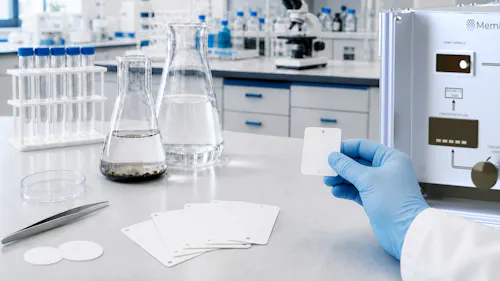
This variability is especially important when comparing results across different PFAS compounds. A membrane that performs well for one compound may not provide the same level of rejection for another, even when both compounds are present in the same water source. We offer a wide variety of NF and RO flat sheet membranes ready for testing.
Why Short-Chain PFAS Are More Difficult to Remove
PFAS compounds are commonly classified as long-chain or short-chain according to their carbon chain length. Long-chain compounds, including PFOA and PFOS, have largely been phased out in the United States and Europe but remain widespread environmental contaminants. Short-chain compounds, including perfluorobutanoic acid (PFBA) and perfluorobutane sulfonic acid (PFBS), are also highly persistent and are generally more soluble and mobile in water.
Short-chain PFAS present a particular separation challenge because they are smaller, less hydrophobic, and more water-soluble than long-chain compounds. These characteristics can reduce their interaction with membrane surfaces and make them more difficult to reject through size exclusion alone [4,5].
The increasing use of short-chain PFAS as replacements for legacy compounds also means that historical performance data for PFOA and PFOS may not accurately predict treatment performance for current influent streams. Membrane evaluation must therefore consider the specific PFAS compounds present rather than treating PFAS as a single contaminant class.
Membrane Performance Depends on More Than Pore Size
Membrane pore size and molecular weight cutoff are important, but they do not fully explain PFAS rejection. Surface charge, zeta potential, and electrostatic interactions between PFAS molecules and the membrane surface can also play a significant role [5].
Many PFAS molecules are negatively charged under typical water-treatment conditions. A negatively charged membrane surface may increase rejection through electrostatic repulsion, while changes in pH or ionic strength can weaken or strengthen those interactions. Hydrophobic interactions, concentration polarization, fouling, and competition from other dissolved constituents can further alter membrane performance.
The combined influence of these mechanisms explains why membranes with similar nominal cutoffs can produce different PFAS rejection results. Effective membrane selection therefore requires consideration of both physical separation and surface chemistry.
Key factors affecting PFAS rejection
- PFAS chain length Short-chain compounds are generally smaller, more soluble, and more difficult to reject than long-chain PFAS.
- Membrane surface charge Electrostatic repulsion or attraction can increase or decrease rejection depending on membrane and solute charge.
- Feedwater pH Changes PFAS ionization and membrane surface charge, affecting electrostatic interactions.
- Ionic strength Can screen electrostatic forces and alter the effective interaction between PFAS and the membrane surface.
- Other dissolved constituents Organic matter, salts, and competing contaminants may affect fouling, adsorption, and transport behavior.
- Operating conditions Pressure, recovery, flux, and concentration polarization can change observed membrane performance.
Emerging Membrane Materials for Short-Chain PFA
Researchers are developing membrane materials that combine narrow transport pathways with stronger electrostatic or adsorptive interactions. These designs seek to improve short-chain PFAS rejection without relying solely on conventional size exclusion.
MXenes are two-dimensional transition-metal carbides and nitrides with hydrophilic surface groups that can alter membrane charge and transport behavior. One MXene-reinforced thin-film polyamide NF membrane achieved 96.85% rejection of PFHxS under the reported test conditions [6].
Metal-organic frameworks (MOFs) offer another approach because their pore structure and surface chemistry can be tuned. A polyamide-modified Cu-TCPP MOF membrane formed narrow, negatively charged transport channels and achieved 84.2% rejection of PFBA, the smallest short-chain PFAS evaluated in the study [7].
Although these materials remain an active area of research, they demonstrate how engineered surface chemistry and nanopore structure may improve PFAS separation beyond the capabilities of conventional membranes. The newly developed materials can be initially tested with dead end cell such as HP4750 Stirred Cell. Once the proof of concept is done, the newly developed membrane can be further tested under cross flow conditions using Cross/Tangential Benchtop Filtration System or Skid Mount Membrane System for larger scale.
Conclusion
RO and NF membranes offer some of the most effective available approaches for separating PFAS from water, but performance cannot be predicted from membrane pore size alone. PFAS chain length, membrane surface charge, feedwater chemistry, and operating conditions all influence rejection.
As regulatory attention expands toward short-chain PFAS, emerging membrane materials that combine size exclusion with electrostatic and adsorptive mechanisms may help address the limitations of conventional membrane technologies. The continued development of these materials reflects a broader shift toward membrane designs engineered for the specific chemical and transport behavior of PFAS.
References
[1] U.S. Environmental Protection Agency, “EPA advances comprehensive PFAS strategy with legally defensible, practical, scientifically sound drinking water protections,” EPA News Releases, May 18, 2026. [Online]. Available: https://www.epa.gov/newsreleases/epa-advances-comprehensive-pfas-strategy-legally-defensible-practical-scientifically
[2] R. Hasan, J. Chen, P. Mojahednia, S.-A. Samaei, and J. Xue, “Comparative analysis of commercial and novel high-pressure membranes for perfluoroalkyl and polyfluoroalkyl substances (PFAS) removal,” Water Environment Research, vol. 97, no. 8, Art. no. e70157, Aug. 2025, doi: 10.1002/wer.70157.
[3] Á. Soriano, D. Gorri, and A. Urtiaga, “Selection of high flux membrane for the effective removal of short-chain perfluorocarboxylic acids,” Industrial & Engineering Chemistry Research, vol. 58, no. 8, pp. 3329–3338, 2019, doi: 10.1021/acs.iecr.8b05506.
[4] M. Bartlett, “Short-chain PFAS, more difficult to remove from drinking water,” ELG Law, Aug. 7, 2023. Accessed Jul. 6, 2026. [Online]. Available: https://www.elglaw.com/blog/short-chain-pfas-difficult-remove-drinking-water/
[5] S. Das and A. Ronen, “A review on removal and destruction of per- and polyfluoroalkyl substances (PFAS) by novel membranes,” Membranes, vol. 12, no. 7, p. 662, Jun. 2022, doi: 10.3390/membranes12070662.
[6] J. Ma, Y. Wang, H. Xu, M. Ding, and L. Gao, “MXene (Ti₃C₂Tₓ)-reinforced thin-film polyamide nanofiltration membrane for short-chain perfluorinated compounds removal,” Process Safety and Environmental Protection, vol. 168, pp. 275–284, 2022.
[7] K. Zhang, P. Cheng, Y. Liu, and S. Xia, “Efficient removal of per- and polyfluoroalkyl substances by a metal-organic framework membrane with high selectivity and stability,” Water Research, vol. 265, Art. no. 122276, 2024, doi: 10.1016/j.watres.2024.122276.