
Membrane Distillation for High-Salinity Water Treatment
· Emerging Technologies
Treating high salinity water is one of the more challenging problems in the water treatment industry. These streams are generated across a range of industrial processes, including oil and gas produced water, desalination brine, mining water, and industrial wastewater. The osmotic pressure of solution increases as salinity increases, which increases the energy consumption and stress in cross flow membranes.
Membrane distillation (MD) offers a compelling alternative to pressure-driven membrane processes. Rather than relying on hydraulic pressure to force water through a membrane, MD uses a temperature gradient to drive water vapor across a hydrophobic, microporous membrane, leaving dissolved salts and other non-volatile contaminants behind [1].
Since MD is primarily driven by vapor pressure differences rather than osmotic pressure, MD's performance is largely unaffected by feed salinity [2], making it uniquely suited for treating brine that would overwhelm pressure driven membrane processes.
How Membrane Distillation Works
In an MD process, warm high-salinity brine runs on the feed side of the membrane testing cell, while a cooler solution runs on the opposite side of the cell. This temperature gradient creates a vapor pressure difference that drives water molecules to:
- Evaporate at the warm surface
- Pass through the membrane's pores as vapor
- Condense on the cooler side as pure water
Under properly controlled operating conditions, the membrane’s hydrophobic pores prevent liquid water from entering. Dissolved salts and other nonvolatile substances are therefore retained in the concentrate stream. As this process continues, the feed becomes progressively more concentrated, allowing MD to keep producing clean water even as the brine approaches saturation.
Use Cases for High-Salinity Streams
Oilfield Produced Water
MD was used for treatment of oil field produced water using a hydrophobic polypropylene (PP) membrane with 0.2 μm pore size [3]. The obtained results indicated the great potential of DCMD to treat hypersaline oil field produced water with an overall rejection of salts higher than 99.9% and that of total organic carbon (TOC) greater than 93.3%.
Reverse Osmosis Brine Concentration
MD was used as a complementary process to RO to further concentrate RO brines and increase the global recovery of the process [4]. A recovery rate of 89% can be obtained using a hybrid RO/MD process.
Hydraulic-Fracturing Produced Water
Combined Electrocoagulation and MD may be used to treat Hydraulic-fracturing produced water to maximize water recovery and minimize the volume of concentrated brine that must be disposed to the environment [5]. The hybrid EC/MD process obtained a recovery rate of 57%.
Lithium-Brine Preconcentration
Membrane distillation was used for the preconcentration of lithium from Salt Lake [6]. The study demonstrated that employing MD processes in preconcentrating lithium from Salt Lake can effectively extract valuable lithium resources through downstream processes.
Evaluating Membrane Distillation at Lab Scale
Laboratory testing allows researchers to compare membranes, operating conditions, and MD configurations before scaling a process.
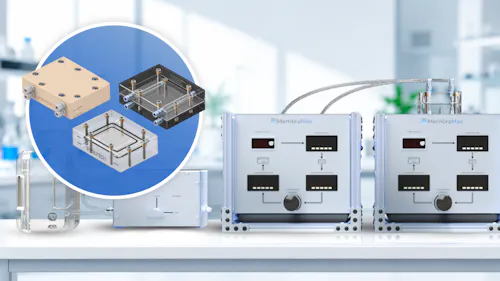
Sterlitech offers membrane distillation cells for direct contact, air gap, vacuum-assisted membrane distillation configurations. These cells allow researchers to evaluate membrane performance under controlled feed temperature, flow, pressure, and concentration conditions.
For researchers ready to progress beyond individual test-cell experiments, the MembraMax MD system provides a larger-scale benchtop platform for continued process development and optimization. The system allows researchers to build on initial cell-testing results while evaluating variables such as permeate flux, salt rejection, operating temperature, feed concentration, and membrane performance under more integrated operating conditions.
Advancing High-Salinity Water Treatment
Membrane distillation offers a promising approach for treating high-salinity streams where conventional pressure-driven membrane processes become less practical. Its ability to maintain high salt rejection at elevated salinities makes MD more suitable for brine concentration, water recovery, and resource recovery applications.
Successful implementation requires careful evaluation of membrane wetting, scaling, fouling, thermal efficiency, and feed pretreatment. Sterlitech’s membrane distillation cells and MembraMax MD system support controlled lab-scale studies to help researchers identify suitable membranes and operating conditions for their applications.
Ask an expert to discuss membrane distillation cells or systems for evaluating high-salinity feed streams.
References
[1] Aihua Zhu, Panagiotis D. Christofides and Yoram Cohen, ‘Energy Consumption Optimization of Reverse Osmosis Membrane Water Desalination Subject to Feed Salinity Fluctuation’, Industrial & Engineering Chemistry Research, 48.21 (2009), pp. 9581–9589.
[2] Leland M. Vane, ‘Water Recovery from Brines and Salt-Saturated Solutions: Operability and Thermodynamic Efficiency Considerations for Desalination Technologies’, Journal of Chemical Technology & Biotechnology, 92.10 (2017), pp. 2506–2518, doi:10.1002/jctb.5225.
[3] M. Al-Salmi et al., ‘Application of membrane distillation for the treatment of oil field produced water’, Desalination, 494 (2020), 114678
[4] J.-P. Mericq, S. Laborie and C. Cabassud, ‘Vacuum membrane distillation of seawater reverse osmosis brines’, Water Research, 44.18 (2010), pp. 5260–5273.
[5] K. Sardari, P. Fyfe, D. Lincicome and S. R. Wickramasinghe, ‘Combined electrocoagulation and membrane distillation for treating high salinity produced waters’, Journal of Membrane Science, 564 (2018), pp. 82–96.
[6] Q. Guo, Y. Liu, T. Li, S. Li, L. Zhang and S. Yin, ‘Pre-concentration of lithium-rich brine via direct contact membrane distillation: Conditional analysis’, Chemical Engineering Research and Design, 208 (2024), pp. 540–549