
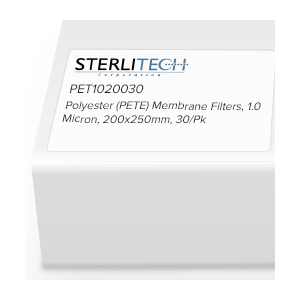
Polyester (PETE) Membrane Filters, 1.0 Micron, 200 x 250mm, 30/Pk
Sterlitech polyester track etch (PETE) membrane filters, 1 micron pore size, 200 x 250 mm sheets, pack of 30. | Membrane Filter Sheets | Sterlitech Corporation
 Powered by Bioz
PETE Membrane Filter Specifications
General
| USP Class VI Testing | Passed |
| Sterilization | Gamma Irradiation, EtO, Autoclave |
| Wetting Characteristics | Naturally Hydrophilic |
| BSA Protein Binding | < 5 μg/cm2 |
| Extactables | Very Low |
| Max. Operating Temp | 140 °C (284 °F) |
| Sealing Compatibility | Ultrasonic, Heat, Radio Frequency, and Insert Molding |
| pH Range | 4-8 |
| Burst Strength Min. | 0.7 bar (10 psi) |
Performance by Pore Sizea
| Pore Densityb (pores/cm2) |
Open Area (%) | Nom. Thicknessc (µm) |
Nom. Weight (mg/cm2) |
Bubble Pointd (psi) |
Water Flow Ratee (mL/min/cm2) |
Air Flow Ratef (L/min/cm2) |
|
|---|---|---|---|---|---|---|---|
| 0.1 µm | 4 x 10⁸ | 3.1 | 10 | 0.8 | 30 | 2.5 | 1.5 |
| 0.2 µm | 3 x 10⁸ | 9.4 | 10 | 1.3 | 20 | 10 | 3 |
| 0.4 µm | 1 x 10⁸ | 12.6 | 10 | 1.2 | 12 | 33 | 7.5 |
| 0.4 µm transparent | 2 x 10⁶ | 0.3 | 12 | 1.7 | - | - | - |
| 0.8 µm | 3 x 10⁷ | 15.1 | 9 | 1.1 | 7 | 90 | 18 |
| 1.0 µm | 2 x 10⁷ | 15.7 | 11 | 1.3 | 6 | 130 | 20 |
| 2.0 µm | 2 x 10⁶ | 6.3 | 10 | 1.3 | 3 | 300 | 16.5 |
| 3.0 µm | 2 x 10⁶ | 14.1 | 9 | 1.1 | 2 | 440 | 37.5 |
| 3.0 µm transparent | 6 x 10⁵ | 4.2 | 12 | 1.6 | - | - | - |
| 5.0 µm | 4 x 10⁵ | 7.9 | 10 | 1.3 | 1.2 | 700 | 30 |
| 8.0 µm | 1 x 10⁵ | 5.0 | 7 | 1.0 | 0.7 | 1000 | 30 |
| 10.0 µm | 1 x 10⁵ | 7.9 | 9 | 1.3 | 0.9 | 1150 | 34.5 |
*Notes:
a. Tolerance + 0%, -20%
b. Tolerance +/-15%
c. Tolerance +/-10%
d. Measured using isopropanol (IPA)
e. Initial flow rates using prefiltered water at 10 psi (0.7 kg/cm2)
f. Initial flow rates using prefiltered air at 10 psi (0.7 kg/cm2) for pore sizes <= 2 µm and 5 psi (0.35 kg/cm2) for pore sizes >= 3 µm
PETE Membrane Filter Applications
- Precise General Filtration and Prefiltration
- Removal of red blood cells from plasma
- Flow control of reagents through assay

Check out other related products below!


 Frequently Asked Questions
Q: What is the difference between hydrophilic and hydrophobic membrane filters?
The pores of microporous membrane filters act as small capillaries. When hydrophilic membranes come into contact with water, capillary action associated with surface tension forces causes the water to spontaneously enter and fill the pores. In this manner, the membranes are easily wetted and allow the bulk flow of water through the pores. Once wetted, hydrophilic membranes will not allow the bulk flow of air or other gasses, unless they are applied at pressures greater than the membrane’s bubble point.
Hydrophilic membrane filters are typically used with water and aqueous solutions. They can also be used with compatible non-aqueous fluids. Hydrophilic membrane filters are typically not used for air, gas or vent filtration since the filters would block flow if inadvertently wetted, by condensation for example.
When hydrophobic membranes come into contact with water, surface tension forces act to repel the water from the pores. Water will not enter the pores and the membranes will act as a barrier to water flow, unless the water is applied at pressures greater than the membrane’s water entry pressure. Low surface tension fluids, such as alcohols, can spontaneously enter and fill the pores of hydrophobic membranes. Once all the air in the pores is displaced, there are no longer any surface tension forces and water can easily enter the pores, displace the low surface tension fluid, and pass through the membrane. The membrane will then allow bulk flow of water for as long as the pore remain water filled. If the membrane is allowed to dry (i.e. air enters the pores), then it must be pre-wet with a low surface tension fluid again prior to use with water.
Hydrophobic membrane filters are typically used with compatible non-aqueous fluids. They are also commonly used as air, gas, or vent filters. Hydrophobic membrane filters are sometimes used with water or aqueous solutions; and, in these applications, they must first be prewet with a low surface tension, water miscible fluid prior to use.
Q: What is a Polycarbonate or Polyester Track Etch filter membrane?
Polycarbonate (PC) and Polyester (PET) track-etch membrane filters are precision, two-dimensional microporous “screen” membranes with straight-through, cylindrical pores created by the track-etching process. Because the pore structure is uniform and non-tortuous, particles are captured primarily on the membrane surface, providing a highly accurate and reproducible separation cut-off compared to depth filter media.
Track-etch membranes are known for having some of the most precise pore size distributions of any membrane filter, making them ideal for applications that require exact particle sizing and surface capture, such as microscopy, particle analysis, microbial enumeration, and sample preparation.
These membranes are also very thin (typically ~6–15 µm) yet surprisingly durable, and can withstand high differential pressures (over 3,000 psi when properly supported). They are available in a range of appearances, from opaque to nearly transparent, including black options for enhanced contrast in imaging and microscopy.
Q: What are the advantages of Sterlitech polycarbonate and polyester membrane filters?
Sterlitech Polycarbonate (PCTE) and Polyester (PETE) track-etched filter membranes offer ultra-low non-specific binding and a smooth, flat surface that captures particles on a single plane—ideal for microscopy, SEM, and particle analysis. Manufactured under Class 100 cleanroom conditions, they are contaminant- and pyrogen-free, with very low extractables and no fiber shedding. Both membranes are biologically inert, provide precise, uniform pore sizes, and deliver excellent chemical and thermal stability, with PETE offering higher solvent resistance.
Q: Do cells adhere to the surface of the Sterlitech track etch membranes?
Depending on the cell line, most exfoliated human cells adhere with some tenacity. Most epithelial cells will adhere if the membrane has a negative charge applied by gas plasma or has a suitable attractant applied to the surface of the membrane. Endothelial cells will generally not attach to the surface of Track Etch membranes.
Q: Why offer both polyester and polycarbonate track-etch filter membranes?
Q. Why offer both polyester and polycarbonate track-etch filter membranes?
A. The greatest advantage of using polyester is that it has better solvent resistance and it is prone to fewer wrinkles in the manufacturing process. One of the main reasons polycarbonate was originally used and continues to be used by most people is that for over 30 years the end-users have known mainly polycarbonate.
Polycarbonate works better with live or fixed cells than does polyester. However, both polycarbonate and polyester offer very high quality end product that is suitable for a large variety of applications.
Q: I just received a box of Sterlitech Track-Etch filter membranes and I am trying to use them, but there is no liquid passing through. What is wrong?
Q. I just received a box of Sterlitech Track-Etch filter membranes and I am trying to use them, but there is no liquid passing through. What is wrong?
A. Believe it or not, in most cases end-users tend to use the blue separator paper instead of the membrane because the separator paper has the physical qualities that make it look more like a typical depth filter than the Track-Etch filter membrane.
Always remember that the filter membrane is usually opaque or translucent and is generally white or white with a yellow or green tint to it. The separator paper is usually blue or imprinted and should not be used for filtration.
Another reason for lack of filtration is due to particle loading on the membrane that would cause the filter to plug. Because Sterlitech Track-Etch filter membranes are made of plastic with cylindrical pores, they capture 100% of all particles larger than the pore size. Therefore, they have a higher incidence of plugging due to their high level of capturability. It is highly recommended that unless the end-user is capturing particles on the surface for analysis that a glass fiber prefilter is used on top of the track-etch membrane. The glass fiber prefilter will capture most of the larger particulate, thereby keeping it from loading up on the surface of the membrane and plugging it.
The use of a mesh spacer (drain disks) is also helpful for maximizing flow. A mesh spacer is set under the membrane and on top of the filter holder. The mesh spacer lifts the membrane off the mostly solid filter holder surface, allowing increased filtration by allowing tangential flow to occur. This is particularly applicable with stainless steel supports.
Q: Are the polycarbonate track-etch (PCTE) membrane filters biocompatible?
Q. What are the advantatges of Sterlitech polycarbonate and polyester membrane filters?
A. Yes, the polycarbonate track-etch (PCTE) membrane filters have good biocompatibility and pass USP Class VI testing. The PCTE membrane filters are neither cytotoxic nor bactericidal. Cells and bacteria will grow on the filters when proper nutrients are supplied and proper conditions are maintained.
Q: What membrane works best for cell studies?
Q. What membrane works best for cell studies?
A. Sterlitech Polycarbonate (PCTE) and Polyester (PETE) membranes are ideal for cell studies. They are neither cytotoxic nor bactericidal. Cells will grow on the membranes if provided with a nutrient.
The membranes can be repeatedly autoclaved at 121°C (250°F), and no damage has been observed in membranes with a sustained exposure to temperatures of 140°C (284°F) in air or steam.
PCTE membranes are neutral biologically, being neither cytotoxic nor bactericidal. Cells and bacteria will grow on PCTE membranes when proper nutrients are supplied. PCTE membranes pass all USP Class VI tests for bio-compatibility and are completely safe to use in implant studies.
Randomly selected samples of polycarbonate and polyester track-etched membranes were tested by an independent laboratory with MEM Extract/L929 Mouse Fibroblast Cells. No evidence of cytotoxic response was noted during a seventy-two (72) hour exposure period, and the materials were judged to be negatively cytotoxic.
Q: Is there any way I can get rid of the pores on Sterlitech's Track-Etch membrane filters?
Q. Is there any way I can get rid of the pores on Sterlitech's Track-Etch filter membranes?
A. If you want to completely get rid of the pores, the easiest way to do so is to dissolve the filter away using chloroform or touch prep.
Q: Can you provide polycarbonate track-etched (PCTE) membrane filters or polyester track-etched (PETE) membrane filters with custom specifications?
Yes, in some cases within manufacturing capabilities, Sterlitech can provide track-etch membrane filters with non-standard custom specifications for pore diameter, pore density, membrane thickness, and surface treatments. Please contact us at [email protected] to discuss your application and to inquire about availability.
Q: Do Track Etched Membranes have a shelf life?
Thickness, Bubble Point, Pore Size, and Pore Density remain unchanged when stored at a temperature from +5 to 35°C and a humidity of 20 to 80 % for up to 8 years
Q: What are the advantages of PETE membrane filters?
Sterlitech polyester track-etch (PETE) membrane filters are made from integral polyethylene terephthalate films. This construction ensures no potential for sloughing or particle shedding and broad chemical compatibility. Inherently hydrophilic, the filters do not require PVP treatment. They exhibit virtually the lowest extractables and adsorption characteristics for any polymeric membrane filters ensuring filtrate purity. Particles are retained on a flat, glass-like smooth surface with an even distribution in a single plane, facilitating microscopic and SEM analyses of the retentate. The PETE membrane filters have superior resistance to high operating pressures when used in appropriate holders.
Q: What solvents can I use to dissolve PCTE or PETE membrane filters?
The polycarbonate track-etch (PCTE) membrane filters can be dissolved with dipolar aprotic solvents such as dimethylformamide (DMF), dimethyl sulfoxide (DMSO) and n-methyl-2-pyrrolidone (NMP). The PCTE membrane filters can also be dissolved with the organic chlorinated solvents dichloromethane (DCM or methylene chloride) and trichloromethane (TCM or chloroform). PCTE membrane filters can also be dissolved with toluene and potentially with other similar aromatic hydrocarbon solvents.
The polyester track-etch (PETE) membrane filters can be dissolved with m-Cresol, o-Chlorophenol, hexafluoroisopropanol, and trifluoroacetic acid (TFA).
Both types of track-etch membranes can be dissolved with elevated temperature sodium hydroxide solutions.
Q: What kind of polyester is used to make your polyester track etch (PETE) membranes?
Sterlitech Polyester Track-Etched (PETE) membrane filters are made from polyethylene terephthalate (PET)—a durable polyester film known for its strength, dimensional stability, and chemical resistance, making it ideal for track-etched membrane filtration and microscopy/particle analysis applications.
Q: Will Sterlitech polyester tract-etch (PETE) or polycarbonate track-etch (PCTE) membrane filters keep liquid behind the filter while allowing gases pass through?
No—Sterlitech PCTE and PETE track-etched membranes are not ideal vent filters unless they are hydrophobic and have sufficient water entry pressure. Standard polycarbonate (PCTE) membranes, even when hydrophobic, typically have low water entry pressure and can allow liquid water to pass under relatively low differential pressure.
For applications that must retain liquid while allowing gases or water vapor to pass, Sterlitech recommends hydrophobic PTFE or hydrophobic/oleophobic PETE membranes, which provide much higher water entry pressure and are commonly used as vent filters in laboratory and industrial systems.
Q: Can I measure the pore size of polyester track-etch (PETE) membrane filters with a SEM?
Yes—you can estimate the pore size of Sterlitech PETE (polyester track-etched) membrane filters using SEM imaging, and SEM is commonly used to characterize track-etched pore diameters during manufacturing. However, pore size measurements can vary between instruments due to SEM calibration, magnification accuracy, image resolution, sample preparation, coating thickness, and measurement method. Because of these variables, user-measured pore diameters may not exactly match Sterlitech’s manufacturing pore size specifications. For best accuracy, use a calibrated scale standard, measure multiple pores across several fields of view, and report results as an average with a distribution.
Q: Do you need a Chemical Compatibility Chart?
We have a Chemical Compatibility Chart that you can use for reference.
Q: What is the difference between nominal and absolute pore size ratings?
Nominal pore size ratings provide a general indication of filter retention efficiency, meaning some particles equal to or larger than the stated pore size may pass through the filter. Nominal ratings can vary by manufacturer, so filters with the same nominal pore size may not offer equivalent filtration performance.
Absolute pore size ratings are determined through controlled particle or microbial retention testing and represent the smallest particles that are consistently retained by the membrane. These ratings are often correlated with bubble point specifications and are generally more comparable across manufacturers.
Important: Actual filtration performance depends on application conditions, even when using filters with absolute pore size ratings.
Q: What is the difference between pore size and porosity?
The pore size refers to the diameter of the individual pores in a membrane filter. Pore size is typically specified in micrometers (µm). Most membranes and filter media actually contain a distribution of pore sizes. Nominal pore size ratings typically refer to the predominant pore size of a filtration media; pores larger and smaller than the nominal rating may be present. Absolute pore size ratings typically refer to the largest pore size of a membrane and it is expected that all pores will be equal to or smaller than the absolute rating.
For the polycarbonate track-etch (PCTE) and polyester track-etch (PETE) membrane filters, porosity is the percent of the total surface area occupied by the pores; it typically ranges from <1% to 16%. For the other membrane filters, porosity is the percent of the total volume occupied by the pores; it typically ranges from 40 to 80%.
Q: How do I determine if my filter is compatible with my application?
You can find the Sterlitech compatibility guide. It is important to realize that application conditions, such as operating temperature, affect compatibility. Please contact us at [email protected] if you need assistance.
Q: What is a bubble point and how is it determined?
The bubble point is the minimum amount of pressure required to push air bubbles through the largest pore of a wet membrane. The bubble point is inversely proportional to the pore diameter, as the pore diameter decreases the bubble point increases and vice versa.
Retention efficiency of membrane filters can be directly measured by challenging the filters with suspensions of standard microorganism cultures or particles of known size. Unfortunately, such efficiency testing is necessarily destructive. However, since retention characteristics are dependent on pore size, it is possible to correlate destructive challenge testing results to non-destructive membrane bubble point tests. In this manner, the relationship between membrane pore size and membrane bubble point is empirically determined. Typically, a minimum bubble point can be determined and specified for a particular pore size rating. The bubble point specification is then used for quality control during membrane manufacture. The bubble point can also be used by the consumer as a nondestructive test to verify membrane integrity before and/or after use.
Q: What is the difference between a depth filter and membrane filter?
Depth filters are constructed with relatively thick filtration media and typically have nominal pore size ratings >1µm. Due to their large void volume, they capture significant amounts of particulate within their pore structure.
Membrane filters are typically composed of polymers that have been chemically processed, resulting in highly porous thin films with microscopic pore structures. Membrane filters typically have absolute pore size ratings <1µm, with some exceptions. Because of their very fine pore structure, membrane filters tend to trap the majority of particles on the surface. However, smaller particles with diameters near or below the pore size rating can be captured within the membrane or pass through the membrane.
Q: What's the benefit of purchasing sample packs?
Sample packs allow the customer to purchase small quantities of membrane filters at nominal cost, with various diameters and pore sizes as selected. This allows the customer to preform trials as needed to determine the optimal filter for their application before committing to purchasing standard pack quantities.
Q: Are membrane filter samples available in diameters others than 13, 25, or 47mm?
In most cases, membrane filter samples can be purchased in sizes that are not listed in the standard sample packs. Please contact us at [email protected] to inquire about availability and pricing.
Q: How can I tell the difference between the separator papers and the membrane filters?
To ensure ease of use, the membrane filters as stacked in their packaging are interleafed with layers of separator paper. In most cases, the membrane filters will be white in color except for the track-etch membranes which are colorless and translucent. In some special cases, the membranes will be dyed dark grey to black in appearance. In all cases, the separator paper will be a different color than the membrane and is usually not white. Please contact us at [email protected] if you need assistance.
