
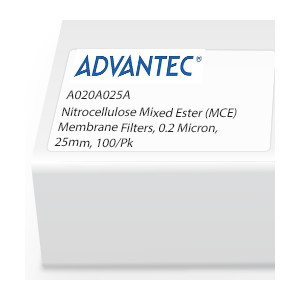
Nitrocellulose Mixed Ester (MCE) Membrane Filters, 0.2 Micron, 25mm, 100/Pk
Sterlitech MCE, a mixture of nitrocellulose and cellulose acetate, meets rigorous quality standards throughout every step of production. This process ensures the membrane has a uniform pore structure and consistent thickness and cosmetic characteristics.
 Powered by Bioz
| USP Class VI Testing | Passed |
| BSA Protein Binding | ~160 μg/cm2 |
| Extractables | <4% |
| Max. Operating Temp | 130 °C (266 °F) |
| Sealing Compatibility | Ultrasonic, Heat, Radio Frequency, and Insert Molding |
| Nominal Thickness | 150 µm |
Performance by Pore Size
| Air Flow Rate1 | Water Flow Rate2 | Bubble Point (psi)3 | |
| 0.10 µm | 0.67 | 2.7 | 35.3 |
| 0.20 µm | 2.4 | 17.5 | 54.5 |
| 0.45 µm | 5.0 | 45.0 | 35.0 |
| 0.65 µm | 11.2 | 120.0 | 21.3 |
| 0.80 µm | 15.0 | 165.0 | 16.4 |
| 1.00 µm | 20.4 | 220.0 | 13.9 |
| 3.00 µm | 28.3 | 300.0 | 10.2 |
| 5.00 µm | 40.9 | 400.0 | 8.5 |
| 8.00 µm | 65.0 | NA | 4.0 |
1. Airflow measured as L/min·cm² at 10psi differential pressure
2. Water flow measured as mL/min·cm² at 10psi differential pressure
3. Bubble point for 0.1µm pore size measured using 100% IPA. All others measured using purified water.
General Filtration
- Sterilizing biological fluids
- Contamination analysis (sterile preferred)
Medical Assays
- hCG
- Chlamydia
- Strep A
- HIV
- Drugs of abuse
- Environmental contaminants
- Pathogenic Microorganisms
Detection Methods
- Immunochromatographic Assays
- Lateral flow Immunoassays with Latex Beads
- Capillary Immunoassays with Colloidal Gold
- Latex Agglutination Assays
Immobilizations
- Dot/Slot Blotting
- Direct Spotting
- Direct-line Applications with a Sprayer
- Immersion and Drying

Check out other related products below!

 Frequently Asked Questions
Q: What is the difference between hydrophilic and hydrophobic membrane filters?
The pores of microporous membrane filters act as small capillaries. When hydrophilic membranes come into contact with water, capillary action associated with surface tension forces causes the water to spontaneously enter and fill the pores. In this manner, the membranes are easily wetted and allow the bulk flow of water through the pores. Once wetted, hydrophilic membranes will not allow the bulk flow of air or other gasses, unless they are applied at pressures greater than the membrane’s bubble point.
Hydrophilic membrane filters are typically used with water and aqueous solutions. They can also be used with compatible non-aqueous fluids. Hydrophilic membrane filters are typically not used for air, gas or vent filtration since the filters would block flow if inadvertently wetted, by condensation for example.
When hydrophobic membranes come into contact with water, surface tension forces act to repel the water from the pores. Water will not enter the pores and the membranes will act as a barrier to water flow, unless the water is applied at pressures greater than the membrane’s water entry pressure. Low surface tension fluids, such as alcohols, can spontaneously enter and fill the pores of hydrophobic membranes. Once all the air in the pores is displaced, there are no longer any surface tension forces and water can easily enter the pores, displace the low surface tension fluid, and pass through the membrane. The membrane will then allow bulk flow of water for as long as the pore remain water filled. If the membrane is allowed to dry (i.e. air enters the pores), then it must be pre-wet with a low surface tension fluid again prior to use with water.
Hydrophobic membrane filters are typically used with compatible non-aqueous fluids. They are also commonly used as air, gas, or vent filters. Hydrophobic membrane filters are sometimes used with water or aqueous solutions; and, in these applications, they must first be prewet with a low surface tension, water miscible fluid prior to use.
Q: What are the advantages of MCE Membranes?
MCE membrane filters offer fast flow rates, high protein-binding capacity, and strong thermal stability, making them a common choice for environmental and biological laboratory filtration. They’re available as presterilized, individually wrapped membranes, and gridded MCE filters can be used for easy microbial colony counting and quantification.
Q: What is the maximum temperature for the different filter membranes?
The maximum operating temperatures for Sterlitech filter membranes are listed below.
- Sterlitech Silver Metal - 427°C
- Sterlitech Ceramic - 350°C
- Sterlitech Polycarbonate Track Etch - 140°C
- Sterlitech Polyester - 140°C
- Sterlitech Nitrocellulose (MCE) - 130°C
- Sterlitech Nylon - 180°C
- Sterlitech Polyethersulfone (PES) - *130°C
- Sterlitech Polypropylene - 82°C
- Sterlitech Cellulose Acetate - 135°C
- Sterlitech PTFE (Laminated) - 130°C
- Sterlitech PTFE (Unlaminated) - 260°C
*5.0um and 8.0um - max temp is 180°C
Q: Do mixed cellulose esters (MCE) membrane filters have a limited shelf life?
Q: What is the shelf life of your membranes?
Cellulose acetate (CA) and nitrocellulose (MCE) membranes will last 2 1/2 to 3 years before reverting to their natural hydrophobic states. Nylon, on the other hand, is naturally hydrophilic so it does not have a shelf life.
An easy test for older membranes is to perform a "wetting out" test. Dipping a small portion of the membrane into water (hydrophilic membranes) or an alcohol (hydrophobic membranes) works well. If the membrane absorbs the material, or "wets out", it has not gone past the shelf life.
Q: Can mixed cellulose esters (MCE) membrane filters be substituted for nitrocellulose (NC) membrane filters?
Ideally, nitrocellulose (NC) membranes would be made entirely of nitrocellulose polymer. However, almost all commercially available filtration grade membrane filters labeled as “nitrocellulose” are actually composed of membranes made with a mixture of nitrocellulose and cellulose acetate polymers. This is because pure nitrocellulose membrane filters are very difficult to manufacture with acceptable characteristics.
In an effort to provide clarity to consumers, some manufactures refer to membranes containing a mixture of nitrocellulose and cellulose acetate polymers as mixed cellulose esters (MCE) membranes. In almost all filtration applications, mixed cellulose esters (MCE) membrane filters are equivalent to nitrocellulose (NC) membrane filters.
Q: Do you need a Chemical Compatibility Chart?
We have a Chemical Compatibility Chart that you can use for reference.
Q: What is the difference between nominal and absolute pore size ratings?
Nominal pore size ratings provide a general indication of filter retention efficiency, meaning some particles equal to or larger than the stated pore size may pass through the filter. Nominal ratings can vary by manufacturer, so filters with the same nominal pore size may not offer equivalent filtration performance.
Absolute pore size ratings are determined through controlled particle or microbial retention testing and represent the smallest particles that are consistently retained by the membrane. These ratings are often correlated with bubble point specifications and are generally more comparable across manufacturers.
Important: Actual filtration performance depends on application conditions, even when using filters with absolute pore size ratings.
Q: Does Sterlitech offer mixed cellulose esters (MCE) membrane disk filters with custom diameters?
Unfortunately, in most instances, we are unable to supply the MCE membrane filters with custom diameters. Please inquire with your Sterlitech sales representative about alternatives.
Q: What is the difference between pore size and porosity?
The pore size refers to the diameter of the individual pores in a membrane filter. Pore size is typically specified in micrometers (µm). Most membranes and filter media actually contain a distribution of pore sizes. Nominal pore size ratings typically refer to the predominant pore size of a filtration media; pores larger and smaller than the nominal rating may be present. Absolute pore size ratings typically refer to the largest pore size of a membrane and it is expected that all pores will be equal to or smaller than the absolute rating.
For the polycarbonate track-etch (PCTE) and polyester track-etch (PETE) membrane filters, porosity is the percent of the total surface area occupied by the pores; it typically ranges from <1% to 16%. For the other membrane filters, porosity is the percent of the total volume occupied by the pores; it typically ranges from 40 to 80%.
Q: Why are non-sterile MCE Membrane filters more expensive than presterilized MCE membranes filters?
Sterile mixed cellulose esters (MCE) membrane filters are used in vast quantities for microbiological studies across many industries and are manufactured in very high volumes to accommodate this demand. Economies of scale and process automation allow the sterile MCE membrane filters to be offered at lower pack costs compared to non-sterile MCE membrane filters. Non-sterile MCE filters are used much less frequently, necessitating less efficient, smaller volume manufacturing runs and packaging methods. Consequently, the non-sterile MCE membrane filters have intrinsically greater manufacturing costs and must be offered at higher prices.
Q: How do I determine if my filter is compatible with my application?
You can find the Sterlitech compatibility guide. It is important to realize that application conditions, such as operating temperature, affect compatibility. Please contact us at [email protected] if you need assistance.
Q: What are the dimensions for the grid printed on the presterilized mixed cellulose esters (MCE) membrane 47 mm disk filters?
The grid dimensions are 3mm x 3mm. The average number of squares for a 47 mm disc filter is 185.
Q: Which membranes are recommended for gravimetric analysis?
A. We have several membranes to recommend for gravimetric analysis.
- Mixed Cellulose Esters (MCE) Membrane Filters, Plain: In gravimetric analysis using ashing techniques, (MCE) Nitrocellulose filters yield a residue of less than 0.045% of their initial weight. They are hydrophilic with a non-cytotoxic wetting agent extractable level of less than 4% of their weight.
- Polycarbonate Track-Etch Membranes (PCTE) - 25mm: Polycarbonate Track-Etch or our Polyester Track-Etch (PETE) membranes are two membranes that offer exceptionally low tare weights, are non-hygroscopic, and exhibit extremely low absorption and adsorption losses.
Since these membranes are non-hygroscopic, they are particularly well suited for gravimetric analysis. They do not require drying when used directly out of the package. If they are wet, they can be dried rapidly and will not pick up moisture from the air during weighing. - Glass Fiber Filters & Prefilters: Glass fiber filters without binders are recommended for analytical and gravimetric determinations.
Q: What is a bubble point and how is it determined?
The bubble point is the minimum amount of pressure required to push air bubbles through the largest pore of a wet membrane. The bubble point is inversely proportional to the pore diameter, as the pore diameter decreases the bubble point increases and vice versa.
Retention efficiency of membrane filters can be directly measured by challenging the filters with suspensions of standard microorganism cultures or particles of known size. Unfortunately, such efficiency testing is necessarily destructive. However, since retention characteristics are dependent on pore size, it is possible to correlate destructive challenge testing results to non-destructive membrane bubble point tests. In this manner, the relationship between membrane pore size and membrane bubble point is empirically determined. Typically, a minimum bubble point can be determined and specified for a particular pore size rating. The bubble point specification is then used for quality control during membrane manufacture. The bubble point can also be used by the consumer as a nondestructive test to verify membrane integrity before and/or after use.
Q: What is the difference between a depth filter and membrane filter?
Depth filters are constructed with relatively thick filtration media and typically have nominal pore size ratings >1µm. Due to their large void volume, they capture significant amounts of particulate within their pore structure.
Membrane filters are typically composed of polymers that have been chemically processed, resulting in highly porous thin films with microscopic pore structures. Membrane filters typically have absolute pore size ratings <1µm, with some exceptions. Because of their very fine pore structure, membrane filters tend to trap the majority of particles on the surface. However, smaller particles with diameters near or below the pore size rating can be captured within the membrane or pass through the membrane.
Q: What's the benefit of purchasing sample packs?
Sample packs allow the customer to purchase small quantities of membrane filters at nominal cost, with various diameters and pore sizes as selected. This allows the customer to preform trials as needed to determine the optimal filter for their application before committing to purchasing standard pack quantities.
Q: Are membrane filter samples available in diameters others than 13, 25, or 47mm?
In most cases, membrane filter samples can be purchased in sizes that are not listed in the standard sample packs. Please contact us at [email protected] to inquire about availability and pricing.
Q: How can I tell the difference between the separator papers and the membrane filters?
To ensure ease of use, the membrane filters as stacked in their packaging are interleafed with layers of separator paper. In most cases, the membrane filters will be white in color except for the track-etch membranes which are colorless and translucent. In some special cases, the membranes will be dyed dark grey to black in appearance. In all cases, the separator paper will be a different color than the membrane and is usually not white. Please contact us at [email protected] if you need assistance.
