Unlock the future of laboratory sample concentration with Sartorius' collection of convenient, pre-assembled crossflow cassettes. Designed for both one-time use and multiple applications, these cassettes empower you to achieve the highest level of efficiency in your lab work.
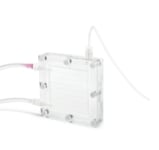
Vivaflow® crossflow devices offer a fast, cost-effective way to concentrate 0.1–5 L samples without large-scale systems. With PES or Hydrosart® membranes and single-use or reusable options, they can achieve up to 50× concentration—1 L in ~30 min or 5 L in <75 min—with near-total recovery after a single buffer rinse.
To reduce protein degradation, optimize buffer composition and minimize shear stress—e.g., use lower centrifuge speeds for linear proteins and devices with membrane areas suited to your starting volume. Vivaflow® crossflow devices minimize shear compared to centrifugal or stirred cell systems, and diafiltration tools like the Vivaflow® reservoir help maintain optimal buffer conditions during concentration.
For virus concentration, use a MWCO ~⅓ of the target’s molecular weight (or match pore size to diameter). For Lentivirus (~90 nm), a 300 kDa Hydrosart® membrane offers the best balance of speed and recovery, with 100 kDa PES as a slower alternative. Always validate device, membrane, and MWCO for your specific virus.
To maximize protein concentration and recovery, match your membrane, MWCO, and device to your protein type. Consider sample properties, membrane material (PES, RC, CTA, HY), and choose a MWCO ~⅓ of target size. Optimize device design, pre-treat to reduce non-specific binding, and use dead-stop pockets or pre-filled filtrate tubes for maximum sample retrieval.
Vivaflow® crossflow devices offer a fast, cost-effective way to concentrate 0.1–5 L samples without large-scale systems. With PES or Hydrosart® membranes and single-use or reusable options, they can achieve up to 50× concentration—1 L in ~30 min or 5 L in <75 min—with near-total recovery after a single buffer rinse.
To reduce protein degradation, optimize buffer composition and minimize shear stress—e.g., use lower centrifuge speeds for linear proteins and devices with membrane areas suited to your starting volume. Vivaflow® crossflow devices minimize shear compared to centrifugal or stirred cell systems, and diafiltration tools like the Vivaflow® reservoir help maintain optimal buffer conditions during concentration.
For virus concentration, use a MWCO ~⅓ of the target’s molecular weight (or match pore size to diameter). For Lentivirus (~90 nm), a 300 kDa Hydrosart® membrane offers the best balance of speed and recovery, with 100 kDa PES as a slower alternative. Always validate device, membrane, and MWCO for your specific virus.
To maximize protein concentration and recovery, match your membrane, MWCO, and device to your protein type. Consider sample properties, membrane material (PES, RC, CTA, HY), and choose a MWCO ~⅓ of target size. Optimize device design, pre-treat to reduce non-specific binding, and use dead-stop pockets or pre-filled filtrate tubes for maximum sample retrieval.
Ask An Expert
As an industry leader focused in unique micro and sub-micron filtration products,
our goal is to support our customers by keeping them at the forefront of their industries. We're here to
help with any filtration questions you might have so you can transform your ideas into reality, and
tackle those big science challenges. Feel free to reach out using the form below, our experts are ready to
serve.



 Frequently Asked Questions