
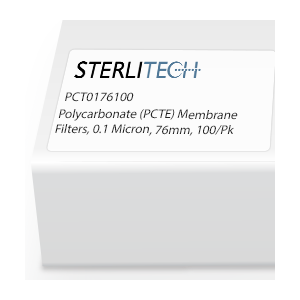
Polycarbonate (PCTE) Membrane Filters, 0.1 Micron, 76mm, 100/Pk
Polycarbonate Track Etch (PCTE) membranes are made from a thin, microporous polycarbonate film material. It is ideally suited for use in blood assays and high-purity and general filtration.
 Powered by Bioz
PCTE Membrane Filter Specifications
General
| USP Class VI Testing | Passed |
| BSA Protein Binding | ~5 μg/cm2 |
| Sterilization | Gamma Irradiation, EtO |
| Max. Operating Temp | 140 °C (284 °F) |
| Sealing Compatibility | Ultrasonic, Heat, Radio Frequency, and Insert Molding |
| pH Range | 4-8 |
| Burst Strength | 0.7 bar (10 psi) |
Performance by Pore Sizea
| Pore Densityb (pores/cm2) |
Open Area (%) |
Nom. Weight (mg/cm2) |
Nom. Thicknessc (µm) |
Bubble Pointd (psi) |
Water Flow Ratee (mL/min/cm2) |
Air Flow Ratef (L/min/cm2) |
|
| 0.01 µm | 6 x 10⁸ | <1 | 0.7 | 6 | NA | 0.1 | 0.0075 |
| 0.03 µm | 6 x 10⁸ | <1 | 0.7 | 6 | NA | 0.2 | 0.075 |
| 0.05 µm | 6 x 10⁸ | 1 | 0.7 | 6 | 50 | 0.4 | 0.37 |
| 0.08 µm | 4 x 10⁸ | 2 | 0.7 | 6 | 38 | 0.6 | 0.75 |
| 0.1 µm | 4 x 10⁸ | 3 | 0.7 | 6 | 30 | 2.5 | 1.5 |
| 0.2 µm | 3 x 10⁸ | 10 | 1.1 | 10 | 20 | 10 | 3 |
| 0.4 µm | 1.5 x 10⁸ | 19 | NA | 24 | 12 | 45 | 7.5 |
| 0.6 µm | 3 x 10⁷ | 8 | 1.0 | 9 | 9 | 60 | 7.5 |
| 0.8 µm | 3 x 10⁷ | 15 | 0.9 | 9 | 7 | 90 | 19 |
| 1.0 µm | 2 x 10⁷ | 16 | 1.1 | 11 | 6 | 130 | 20 |
| 2.0 µm | 2 x 10⁶ | 6 | 1.1 | 10 | 3 | 300 | 16.5 |
| 3.0 µm | 2 x 10⁶ | 14 | 0.9 | 9 | 2 | 440 | 37.5 |
| 5.0 µm | 4 x 10⁵ | 8 | 1.1 | 10 | 1.2 | 700 | 30 |
| 8.0 µm | 1 x 10⁵ | 5 | 0.8 | 7 | 0.7 | 1000 | 30 |
| 10.0 µm | 1 x 10⁵ | 8 | 1.1 | 10 | 0.5 | 1150 | 34.5 |
| 12.0 µm | 1 x 10⁵ | 11.3 | - | 14 | - | - | - |
| 14.0 µm | 5 x 10⁴ | 8 | 0.6 | 6 | 0.2 | 1400 | 63.5 |
| 20.0 µm | 5 x 10⁴ | 13 | - | 32 | - | - | - |
| 25.0 µm | 1 x 10⁴ | 5 | NA | 25 | <1 | >1000 | 33 |
| 30.0 µm | 1 x 10⁴ | 7 | NA | 30 | <1 | >1500 | 50 |
*Notes:
a. Tolerance + 0%, -20%
b. Tolerance +/-15%
c. Tolerance +/-10%
d. Measured using isopropanol (IPA)
e. Initial flow rates using prefiltered water at 10 psi (0.7 kg/cm2)
f. Initial flow rates using prefiltered air at 10 psi (0.7 kg/cm2) for pore sizes <= 2 µm and 5 psi (0.35 kg/cm2) for pore sizes >= 3 µm
Hydrophilic PCTE Membrane Filter Applications
0.01 - 0.1 micron
- Most liposome extrusions (range 0.03 - 0.4 µm)
- Asbestos (water)
- Bacteria removal: Acholeplasma laidwaii
- Removal of colloidal material from water
- Mycoplasma removal
- Tissue culture with collagen: skin graft
- Virus filtration
0.2 - 1.0 micron
- 0.2 µm: General sterile filtration, sterile filtration of corrosive fluids, immunology, implant tissue and cell studies, air venting, aqueous fluids, air and gas sterilizing. FITC stain technique, Legionella pneumophilia - air conditioning water, DNA fragments filtration, phytoplankton, bacteria removal, deionized water-clinical laboratory Type 1 and for semiconductor industry using SEM analysis, and EPA leachate/toxicity testing.
- 0.4 µm: Sterility testing, pulp, paper-adsorbable organic halides-water (AOX), air (asbestos fibers, silica particles pollen), dewatering, purification of cellular suspensions and wine stabilization, immunology - tissue and cell stuides, forensic analysis (SEM), microscopic examination - samples, Water-pollution (Escherichia coli), trace metal analysis (USGS method), nitrates, nitrites, phosphates, and ammonia (low extractable), particle analysis of corrosive fluids, bacteria - Serratia marcescens, and cell culture.
- 0.6 µm: Particle analysis (corrosive fluids), analysis of wine, milk, cells and plasmapheresis.
- Latex Agglutination Assays
- 0.8u µm: General air analysis (asbestos, Cadmium), sugar molds (food), gravimetric analysis, tissue culture partitioning, wine stabilization, alkaline elution (DNA).
- 1.0 µm: Serum pre-filtration, beer stabilization, ultracleaning (corrosive fluids), microfiltration (alcohol solutions), Giardia lamblia (removes most of them), red blood cells (RBC)
- (0.2-0.8 µm): EPA leachate/toxicity testing.
- (0.4-3.0 µm): Cell culture
- (0.6-1.0 µm): Plasmapheresis
2.0 - 30.0 micron
- 2.0 µm: Chemotaxis, alkaline elution (DNA), red blood cells (RBC's)
- 3.0 µm: General microfiltration and clarification, cytological evaluation (cerebrospinal fluid), chemotaxis, red blood cells (RBC), microfiltration of corrosive fluids
- 5.0 µm: Exfoliate cytology, chemotaxis, gravimetric analysis, Gairdia lamblia (3-5um) observation, canine heartworm microfilariae (dirofilaria immitis), erythrocyte deformability (4.7 µm), gross particulate analysis of corrosive fluids (oil, diesel, gas filtration)
- 8.0 µm: Cytology
- 12.0um: Starch, Schistosoma haematobium
- (0.4-3.0 µm): Cell culture
- (8.0-14.0 µm): Larger bacteria, general clarification and pre-filtration of corrosive fluids, most acides, some ester photoresists, reagent grade chemicals and alcohol solutions
- (10.0-12.0 µm): Human melonoma invasion study (cancer-tumors), leukocytes, metastasis tumor cell
- (0.01-20 µm): Scanning electron microscopy (SEM)

Check out other related products below!
 Frequently Asked Questions
Q: What is the difference between hydrophilic and hydrophobic membrane filters?
The pores of microporous membrane filters act as small capillaries. When hydrophilic membranes come into contact with water, capillary action associated with surface tension forces causes the water to spontaneously enter and fill the pores. In this manner, the membranes are easily wetted and allow the bulk flow of water through the pores. Once wetted, hydrophilic membranes will not allow the bulk flow of air or other gasses, unless they are applied at pressures greater than the membrane’s bubble point.
Hydrophilic membrane filters are typically used with water and aqueous solutions. They can also be used with compatible non-aqueous fluids. Hydrophilic membrane filters are typically not used for air, gas or vent filtration since the filters would block flow if inadvertently wetted, by condensation for example.
When hydrophobic membranes come into contact with water, surface tension forces act to repel the water from the pores. Water will not enter the pores and the membranes will act as a barrier to water flow, unless the water is applied at pressures greater than the membrane’s water entry pressure. Low surface tension fluids, such as alcohols, can spontaneously enter and fill the pores of hydrophobic membranes. Once all the air in the pores is displaced, there are no longer any surface tension forces and water can easily enter the pores, displace the low surface tension fluid, and pass through the membrane. The membrane will then allow bulk flow of water for as long as the pore remain water filled. If the membrane is allowed to dry (i.e. air enters the pores), then it must be pre-wet with a low surface tension fluid again prior to use with water.
Hydrophobic membrane filters are typically used with compatible non-aqueous fluids. They are also commonly used as air, gas, or vent filters. Hydrophobic membrane filters are sometimes used with water or aqueous solutions; and, in these applications, they must first be prewet with a low surface tension, water miscible fluid prior to use.
Q: What is a Polycarbonate or Polyester Track Etch filter membrane?
Polycarbonate (PC) and Polyester (PET) track-etch membrane filters are precision, two-dimensional microporous “screen” membranes with straight-through, cylindrical pores created by the track-etching process. Because the pore structure is uniform and non-tortuous, particles are captured primarily on the membrane surface, providing a highly accurate and reproducible separation cut-off compared to depth filter media.
Track-etch membranes are known for having some of the most precise pore size distributions of any membrane filter, making them ideal for applications that require exact particle sizing and surface capture, such as microscopy, particle analysis, microbial enumeration, and sample preparation.
These membranes are also very thin (typically ~6–15 µm) yet surprisingly durable, and can withstand high differential pressures (over 3,000 psi when properly supported). They are available in a range of appearances, from opaque to nearly transparent, including black options for enhanced contrast in imaging and microscopy.
Q: What are the advantages of Sterlitech polycarbonate and polyester membrane filters?
Sterlitech Polycarbonate (PCTE) and Polyester (PETE) track-etched filter membranes offer ultra-low non-specific binding and a smooth, flat surface that captures particles on a single plane—ideal for microscopy, SEM, and particle analysis. Manufactured under Class 100 cleanroom conditions, they are contaminant- and pyrogen-free, with very low extractables and no fiber shedding. Both membranes are biologically inert, provide precise, uniform pore sizes, and deliver excellent chemical and thermal stability, with PETE offering higher solvent resistance.
Q: Will Sterlitech Track Etch filter membranes keep liquid behind the filter and let gases pass through?
Sterlitech Track-Etched Polycarbonate membranes are not recommended for venting applications. PVP-free polycarbonate membranes have a water contact angle of ~90° and can wet out under low differential pressure, allowing liquid to pass through. As a result, they do not effectively retain liquids while venting gases. For vent filter applications where gas permeability and liquid blocking are required, Sterlitech recommends hydrophobic PTFE, hydrophobic polyethylene, or oleophobic polyester membranes, which provide higher water entry pressure and allow gases and water vapor to pass while preventing liquid breakthrough.
Q: Do Sterlitech PCTE membrane filters have any type of wetting agent on them?
Polycarbonate track-etch (PCTE) membranes are inherently
hydrophobic. The hydrophobic PCTE
membrane filters shown at https://www.sterlitech.com/hydrophobic-polycarbonate-membrane-filters.html do not have any wetting agents. Before use in water or aqueous solutions, these filters are usually pre-wet with a compatible low surface tension, water miscible fluid such as a low molecular weight alcohol.
The hydrophilic PCTE membrane filters shown at https://www.sterlitech.com/hydrophilic-polycarbonate-membrane-filters.html are treated with a wetting agent to render the membrane hydrophilic. The wetting agent consists of a few molecular
thicknesses of polyvinylpyrrolidone (PVP) deposited on the membrane
surfaces. The hydrophilic PCTE membrane filters can be used in water or aqueous solutions without pre-wetting.
Q: Can Polycarbonate membrane be bonded with adhesives?
Q. Can Polycarbonate membrane be bonded with adhesives?
A. Polycarbonate membranes can be adhesive bonded to each other or to other plastics, metals, glass or wood using commercially available one component, two component and pressure adhesives.
Q: Do cells adhere to the surface of the Sterlitech track etch membranes?
Depending on the cell line, most exfoliated human cells adhere with some tenacity. Most epithelial cells will adhere if the membrane has a negative charge applied by gas plasma or has a suitable attractant applied to the surface of the membrane. Endothelial cells will generally not attach to the surface of Track Etch membranes.
Q: What is the difference between the shiny side and the dull side of the polycarbonate track-etch (PCTE) membrane filters?
There is a visually apparent difference between the sides of some of the PCTE membrane filters. This is a result of the process used to manufacture the polycarbonate base film. One side of the film has a very smooth surface resulting in a shiny appearance. The other side has an inherent surface texture resulting in a dull or matte appearance. The difference is purely physical; both sides are chemically the same. Filter orientation does not affect particle retention. For applications involving microscopic analyses of captured particles or microbes, most users prefer to orient the disk filter so that the smooth shiny side is facing upstream.
Q: I am looking for a black polycarbonate membrane pore size that is not listed. Can I dye the standard polycarbonate membrane? How do I do this?
Q. I am looking for a black polycarbonate membrane pore size that is not listed. Can I dye the standard polycarbonate membrane? How do I do this?
A. Yes, but we usually recommend the PVP-free polycarbonate membranes. Note that black polycarbonate membranes are used for counting particulates and performing fluorescent microscopy.
If you need to create a black membrane that is not listed on this site, the standard method for rendering polycarbonate membranes black in a lab follows:
Dissolve 2 gm of Irgalan black (Chemical Index, acid black 107) in 1 liter of 2% acetic acid.
Soak membranes in Irgalan black solution for 24 hours.
Rinse with water, air dry.
To obtain a darker black, dry at 180ºF (82ºC) for 15 minutes.
**Note: There have been instances of Irgalan Black "bleeding" off of the membrane. This is not common, but has occurred.
Q: Why offer both polyester and polycarbonate track-etch filter membranes?
Q. Why offer both polyester and polycarbonate track-etch filter membranes?
A. The greatest advantage of using polyester is that it has better solvent resistance and it is prone to fewer wrinkles in the manufacturing process. One of the main reasons polycarbonate was originally used and continues to be used by most people is that for over 30 years the end-users have known mainly polycarbonate.
Polycarbonate works better with live or fixed cells than does polyester. However, both polycarbonate and polyester offer very high quality end product that is suitable for a large variety of applications.
Q: I am having a problem when I force liquids under pressure through a membrane with a very small pore size. Little or no liquid is seen to pass through the membrane, what could be the problem?
Q. I am having a problem when I force liquids under pressure through a membrane with a very small pore size. Little or no liquid is seen to pass through the membrane, what could be the problem?
A. There could be a number of things going on to restrict the flow through the membrane.
First you want to take the original flow rate into consideration, for example a 25mm polycarbonate membrane with a 0.05 micron pore size and a flow rate of 0.4ml/min/cm2 is only going to get about 1.2 mil of liquid through a minute. This amount decreases with smaller pore sizes.
Another thing to consider is if the liquid is being properly prefiltered. With such small pore sizes, 0.05-0.01micron, you need to filter in a step down manner so as not to plug the pores. Step down means a series of filters with decreasing pore size.
This should eliminate most problems with flow through the membrane; other issues need to be evaluated on an individual basis.
Q: I just received a box of Sterlitech Track-Etch filter membranes and I am trying to use them, but there is no liquid passing through. What is wrong?
Q. I just received a box of Sterlitech Track-Etch filter membranes and I am trying to use them, but there is no liquid passing through. What is wrong?
A. Believe it or not, in most cases end-users tend to use the blue separator paper instead of the membrane because the separator paper has the physical qualities that make it look more like a typical depth filter than the Track-Etch filter membrane.
Always remember that the filter membrane is usually opaque or translucent and is generally white or white with a yellow or green tint to it. The separator paper is usually blue or imprinted and should not be used for filtration.
Another reason for lack of filtration is due to particle loading on the membrane that would cause the filter to plug. Because Sterlitech Track-Etch filter membranes are made of plastic with cylindrical pores, they capture 100% of all particles larger than the pore size. Therefore, they have a higher incidence of plugging due to their high level of capturability. It is highly recommended that unless the end-user is capturing particles on the surface for analysis that a glass fiber prefilter is used on top of the track-etch membrane. The glass fiber prefilter will capture most of the larger particulate, thereby keeping it from loading up on the surface of the membrane and plugging it.
The use of a mesh spacer (drain disks) is also helpful for maximizing flow. A mesh spacer is set under the membrane and on top of the filter holder. The mesh spacer lifts the membrane off the mostly solid filter holder surface, allowing increased filtration by allowing tangential flow to occur. This is particularly applicable with stainless steel supports.
Q: We would like a higher density Polycarbonate membrane (PCTE). Is it available?
Q. We would like a higher density Polycarbonate membrane (PCTE). Is it available?
A. Yes, custom density PCTE is available. Please contact our sales team for a quote ([email protected])
Q: Are the polycarbonate track-etch (PCTE) membrane filters biocompatible?
Q. What are the advantatges of Sterlitech polycarbonate and polyester membrane filters?
A. Yes, the polycarbonate track-etch (PCTE) membrane filters have good biocompatibility and pass USP Class VI testing. The PCTE membrane filters are neither cytotoxic nor bactericidal. Cells and bacteria will grow on the filters when proper nutrients are supplied and proper conditions are maintained.
Q: What membrane works best for cell studies?
Q. What membrane works best for cell studies?
A. Sterlitech Polycarbonate (PCTE) and Polyester (PETE) membranes are ideal for cell studies. They are neither cytotoxic nor bactericidal. Cells will grow on the membranes if provided with a nutrient.
The membranes can be repeatedly autoclaved at 121°C (250°F), and no damage has been observed in membranes with a sustained exposure to temperatures of 140°C (284°F) in air or steam.
PCTE membranes are neutral biologically, being neither cytotoxic nor bactericidal. Cells and bacteria will grow on PCTE membranes when proper nutrients are supplied. PCTE membranes pass all USP Class VI tests for bio-compatibility and are completely safe to use in implant studies.
Randomly selected samples of polycarbonate and polyester track-etched membranes were tested by an independent laboratory with MEM Extract/L929 Mouse Fibroblast Cells. No evidence of cytotoxic response was noted during a seventy-two (72) hour exposure period, and the materials were judged to be negatively cytotoxic.
Q: Is there any way I can get rid of the pores on Sterlitech's Track-Etch membrane filters?
Q. Is there any way I can get rid of the pores on Sterlitech's Track-Etch filter membranes?
A. If you want to completely get rid of the pores, the easiest way to do so is to dissolve the filter away using chloroform or touch prep.
Q: How do I remove the PVP hydrophilic coating from the surfaces of a polycarbonate membrane filter?
Q. How do I remove the PVP hydrophilic coating from the surfaces of a polycarbonate membrane filter?
A. Sterlitech’s polycarbonate membranes are naturally hydrophobic but are coated with PVP to produce a hydrophilic version. While the full range of pores sizes (0.01um-30.0um) are available as hydrophilic filters, we are only able to offer a limited number of pore sizes (0.1um-10.0um) as hydrophobic (PVP-Free).
Fortunately, the PVP can be removed without much hassle. Boil the membrane(s) for at least 1 hour in deionized ultra-pure water, remove, then air dry the membrane(s). Once the membrane dries it will be hydrophobic and PVP-Free.
Q: Why are black polycarbonate membrane filters better than others for counting bacteria?
Q. Why are black polycarbonate membranes better than other membranes for counting bacteria?
A. Black polycarbonate membranes are better than cellulose membranes for the direct counting of bacteria, because they have a uniform pore size and a flat surface that retains all of the bacteria on top of the filter. Although cellulose filters also retain all of the bacteria, many become trapped inside the filter where they cannot be counted.
Q: Can you provide polycarbonate track-etched (PCTE) membrane filters or polyester track-etched (PETE) membrane filters with custom specifications?
Yes, in some cases within manufacturing capabilities, Sterlitech can provide track-etch membrane filters with non-standard custom specifications for pore diameter, pore density, membrane thickness, and surface treatments. Please contact us at [email protected] to discuss your application and to inquire about availability.
Q: Do Track Etched Membranes have a shelf life?
Thickness, Bubble Point, Pore Size, and Pore Density remain unchanged when stored at a temperature from +5 to 35°C and a humidity of 20 to 80 % for up to 8 years
Q: Why are black dyed polycarbonate track-etch (PCTE) membrane filters preferred for use in epiflourescence microscopy?
Q: Why are black dyed polycarbonate track-etch (PCTE) membrane filters preferred for use in epiflourescence microscopy?
A: Black dyed PCTE membrane filters provide the same advantages as regular PCTE membrane filters for microscopy applications, but also have exceptionally low autoflourescence. This permits high contrast between flourescent stained microorganisms and the dark surface of the membrane filters. The very low autoflourescence of the black dyed PCTE membrane filters also makes them suitable for applications that use automated detection of flourescently labeled microorganisms such as laser scanning cytometry.
Q: Do polycarbonate track-etch (PCTE) membrane filters contain Bisphenol-A (BPA)?
Q: Do polycarbonate track-etch (PCTE) membrane filters contain Bisphenol-A (BPA)?
A: Bisphenol-A (BPA) is the monomer used to manufacture polycarbonate. It is not expected that the polycarbonate track-etch (PCTE) membrane filters would contain significant residual amounts of BPA. However, the filters are not analyzed on a lot basis for residual BPA so they cannot be described as BPA free. The user is advised that extreme application conditions, including exposure to high temperatures and/or exposure to incompatible fluids, may attack the molecular structure of the polycarbonate and release trace amounts of BPA. For applications where trace amounts of BPA may cause concern, polyester track-etch (PETE) membrane filters may be considered.
Q: How clear are the polycarbonate track-etch (PCTE) membrane filters?
The polycarbonate track-etch (PCTE) membrane filters are quite thin and translucent. Depending on pore size rating and pore density, the filters may appear transparent or may appear opaque. Please review https://www.sterlitech.com/blog/post/clarifying-the-matter-of-polycarbonates-membrane-clarity. In some instances, when PCTE membrane filters with standard specifications appear opaque, Sterlitech can provide custom low pore density filters with the same pore size rating that are transparent. For comparison, most conventional microporous membrane filters are considerably thicker and cannot be made transparent. Please contact us at [email protected] to discuss your application and to inquire about the availability custom PCTE membrane filters.
When performing microscopic studies of particles or cells resting on the surface of PCTE membrane filters, some users may find the appearance of the pore edges to be a hindrance. There are some strategies that can be employed to reduce the appearance of the pore edges. One of the simplest strategies is to dissolve the membrane, with chloroform or toluene for examples, leaving behind the particles. Additionally, using a combination of wetting the membrane with a liquid that has the correct refractive index and illuminating the membrane with polarized light, it is possible to make the pores invisible. The PCTE membrane is birefringent and has two refractive indices, 1.584 and 1.625. To make the pores invisible, the membrane is wetted with a fluid that has a refractive index of 1.584 and is illuminated with properly oriented polarized light.
Q: What solvents can I use to dissolve PCTE or PETE membrane filters?
The polycarbonate track-etch (PCTE) membrane filters can be dissolved with dipolar aprotic solvents such as dimethylformamide (DMF), dimethyl sulfoxide (DMSO) and n-methyl-2-pyrrolidone (NMP). The PCTE membrane filters can also be dissolved with the organic chlorinated solvents dichloromethane (DCM or methylene chloride) and trichloromethane (TCM or chloroform). PCTE membrane filters can also be dissolved with toluene and potentially with other similar aromatic hydrocarbon solvents.
The polyester track-etch (PETE) membrane filters can be dissolved with m-Cresol, o-Chlorophenol, hexafluoroisopropanol, and trifluoroacetic acid (TFA).
Both types of track-etch membranes can be dissolved with elevated temperature sodium hydroxide solutions.
Q: Do you have a method for coating the PVP-Free polycarbonate track-etch (PCTE) membrane filters for Chemotaxis studies?
Membranes are used in the study of white blood cell reactions to toxins (chemotaxis), to determine the natural immunity in whole blood. Since immunity is transferable, this could lead to the development of vaccines for treatment of cancer and other diseases. Membranes may be polycarbonate, with or without polyvinylpyrrolidone (PVP). It depends on the type of cells used. Apparently, Neutrophils have a tendency to round up and fall off the membrane when around PVP - not so with some of the other types of cells. Refer to each procedure. Characteristics of PCTE Membrane and Advantages in Chemotaxis Studies Uniform Properties yield reliable, consistent, and reproducible results. Less cell distortion for improved morphology.
Zero leaching of offensive surfactants yields reliable, consistent, and reproducible results.
Smooth, flat surface contributes to high cell visibility on proximal and distal surfaces. Improved morphologic resolution. Easy removal of excess cells from proximal surface.
Thinness of the membrane allows shorter incubation time. More assays made faster and simpler. Chamber sterilization not needed for most studies. Facilitates study of slower moving cells (e.g., monocytes and macrophages).
Low adsorption and absorption of cells causes higher yields. Enhanced radiometric analysis.
Non-staining results in improved contrast. Simplifies optical microscopic analysis routine.
Transparency simplifies optical microscopic analysis routine.
Heat sealable characteristics aids in experimenting with disposable chambers.
Strength of membrane means that less critical handling techniques needed.
Coating Membranes with Gelatin Wash membrane with 0.5% Acetic Acid.
Make a stock gelatin solution with 50mg/10mL water.
Working solution is 1-mL stock to 1-liter water for a light coating.
Then the membranes are placed in a rolling boil of this solution in a beaker for 1 hour.
The membranes are individually pulled out and placed on filter paper to air dry. If an oven is used, use very low temperature for 20 minutes. Air-drying is best in a covered dish left over night. Keep clean.
When the membranes are dry, place them back in their original box.
NOTE: For Chemotaxis, the most important issue is to keep everything at 37 degrees C., the water bath, buffers, glassware, etc. for 1 hour. Studies in cold produce cells that "round up", curl up and fall off.
Q: Do you need a Chemical Compatibility Chart?
We have a Chemical Compatibility Chart that you can use for reference.
Q: What is the difference between nominal and absolute pore size ratings?
Nominal pore size ratings provide a general indication of filter retention efficiency, meaning some particles equal to or larger than the stated pore size may pass through the filter. Nominal ratings can vary by manufacturer, so filters with the same nominal pore size may not offer equivalent filtration performance.
Absolute pore size ratings are determined through controlled particle or microbial retention testing and represent the smallest particles that are consistently retained by the membrane. These ratings are often correlated with bubble point specifications and are generally more comparable across manufacturers.
Important: Actual filtration performance depends on application conditions, even when using filters with absolute pore size ratings.
Q: What is the difference between pore size and porosity?
The pore size refers to the diameter of the individual pores in a membrane filter. Pore size is typically specified in micrometers (µm). Most membranes and filter media actually contain a distribution of pore sizes. Nominal pore size ratings typically refer to the predominant pore size of a filtration media; pores larger and smaller than the nominal rating may be present. Absolute pore size ratings typically refer to the largest pore size of a membrane and it is expected that all pores will be equal to or smaller than the absolute rating.
For the polycarbonate track-etch (PCTE) and polyester track-etch (PETE) membrane filters, porosity is the percent of the total surface area occupied by the pores; it typically ranges from <1% to 16%. For the other membrane filters, porosity is the percent of the total volume occupied by the pores; it typically ranges from 40 to 80%.
Q: How do I determine if my filter is compatible with my application?
You can find the Sterlitech compatibility guide. It is important to realize that application conditions, such as operating temperature, affect compatibility. Please contact us at [email protected] if you need assistance.
Q: Which membranes are recommended for gravimetric analysis?
A. We have several membranes to recommend for gravimetric analysis.
- Mixed Cellulose Esters (MCE) Membrane Filters, Plain: In gravimetric analysis using ashing techniques, (MCE) Nitrocellulose filters yield a residue of less than 0.045% of their initial weight. They are hydrophilic with a non-cytotoxic wetting agent extractable level of less than 4% of their weight.
- Polycarbonate Track-Etch Membranes (PCTE) - 25mm: Polycarbonate Track-Etch or our Polyester Track-Etch (PETE) membranes are two membranes that offer exceptionally low tare weights, are non-hygroscopic, and exhibit extremely low absorption and adsorption losses.
Since these membranes are non-hygroscopic, they are particularly well suited for gravimetric analysis. They do not require drying when used directly out of the package. If they are wet, they can be dried rapidly and will not pick up moisture from the air during weighing. - Glass Fiber Filters & Prefilters: Glass fiber filters without binders are recommended for analytical and gravimetric determinations.
Q: What is a bubble point and how is it determined?
The bubble point is the minimum amount of pressure required to push air bubbles through the largest pore of a wet membrane. The bubble point is inversely proportional to the pore diameter, as the pore diameter decreases the bubble point increases and vice versa.
Retention efficiency of membrane filters can be directly measured by challenging the filters with suspensions of standard microorganism cultures or particles of known size. Unfortunately, such efficiency testing is necessarily destructive. However, since retention characteristics are dependent on pore size, it is possible to correlate destructive challenge testing results to non-destructive membrane bubble point tests. In this manner, the relationship between membrane pore size and membrane bubble point is empirically determined. Typically, a minimum bubble point can be determined and specified for a particular pore size rating. The bubble point specification is then used for quality control during membrane manufacture. The bubble point can also be used by the consumer as a nondestructive test to verify membrane integrity before and/or after use.
Q: What is the difference between a depth filter and membrane filter?
Depth filters are constructed with relatively thick filtration media and typically have nominal pore size ratings >1µm. Due to their large void volume, they capture significant amounts of particulate within their pore structure.
Membrane filters are typically composed of polymers that have been chemically processed, resulting in highly porous thin films with microscopic pore structures. Membrane filters typically have absolute pore size ratings <1µm, with some exceptions. Because of their very fine pore structure, membrane filters tend to trap the majority of particles on the surface. However, smaller particles with diameters near or below the pore size rating can be captured within the membrane or pass through the membrane.
Q: What's the benefit of purchasing sample packs?
Sample packs allow the customer to purchase small quantities of membrane filters at nominal cost, with various diameters and pore sizes as selected. This allows the customer to preform trials as needed to determine the optimal filter for their application before committing to purchasing standard pack quantities.
Q: Are membrane filter samples available in diameters others than 13, 25, or 47mm?
In most cases, membrane filter samples can be purchased in sizes that are not listed in the standard sample packs. Please contact us at [email protected] to inquire about availability and pricing.
Q: How can I tell the difference between the separator papers and the membrane filters?
To ensure ease of use, the membrane filters as stacked in their packaging are interleafed with layers of separator paper. In most cases, the membrane filters will be white in color except for the track-etch membranes which are colorless and translucent. In some special cases, the membranes will be dyed dark grey to black in appearance. In all cases, the separator paper will be a different color than the membrane and is usually not white. Please contact us at [email protected] if you need assistance.
