
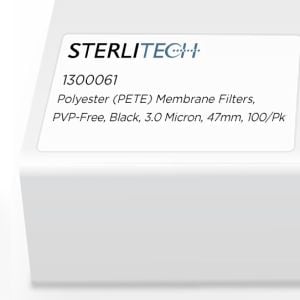
Polyester (PETE) Membrane Filters, PVP-Free, Black, 3.0 Micron, 47mm, 100/Pk
 Powered by Bioz
|
Pore Size (µm) |
Thickness (µm) |
Porosity (%) |
Bubble Point | Pore Density cm2 | Water Flow Ratee indicative values ml/min/cm2 @0.7bar |
Air Flow Ratef indicative values L/min/cm2 @0.7bar |
|---|---|---|---|---|---|---|
| 0.2 µm | 25 (µm) | 15.70% | >3.5 bar | - | >10 | >2 |
| 0.4 µm | 25 (µm) | 18.80% | >2 bar | 1.50 E+08 | >30 | >4 |
| 0.8 µm | 24 (µm) | 20.10% | >0.6 bar | 4.00 E+07 | >80 | >8 |
| 3.0 µm | 22 (µm) | 21.20% | >0.05 bar | 3.00E +06 | >400 | >30 |

Check out other related products below!

 Frequently Asked Questions
Q: What is a Polycarbonate or Polyester Track Etch filter membrane?
Polycarbonate (PC) and Polyester (PET) track-etch membrane filters are precision, two-dimensional microporous “screen” membranes with straight-through, cylindrical pores created by the track-etching process. Because the pore structure is uniform and non-tortuous, particles are captured primarily on the membrane surface, providing a highly accurate and reproducible separation cut-off compared to depth filter media.
Track-etch membranes are known for having some of the most precise pore size distributions of any membrane filter, making them ideal for applications that require exact particle sizing and surface capture, such as microscopy, particle analysis, microbial enumeration, and sample preparation.
These membranes are also very thin (typically ~6–15 µm) yet surprisingly durable, and can withstand high differential pressures (over 3,000 psi when properly supported). They are available in a range of appearances, from opaque to nearly transparent, including black options for enhanced contrast in imaging and microscopy.
Q: What are the advantages of Sterlitech polycarbonate and polyester membrane filters?
Sterlitech Polycarbonate (PCTE) and Polyester (PETE) track-etched filter membranes offer ultra-low non-specific binding and a smooth, flat surface that captures particles on a single plane—ideal for microscopy, SEM, and particle analysis. Manufactured under Class 100 cleanroom conditions, they are contaminant- and pyrogen-free, with very low extractables and no fiber shedding. Both membranes are biologically inert, provide precise, uniform pore sizes, and deliver excellent chemical and thermal stability, with PETE offering higher solvent resistance.
Q: Do cells adhere to the surface of the Sterlitech track etch membranes?
Depending on the cell line, most exfoliated human cells adhere with some tenacity. Most epithelial cells will adhere if the membrane has a negative charge applied by gas plasma or has a suitable attractant applied to the surface of the membrane. Endothelial cells will generally not attach to the surface of Track Etch membranes.
Q: Why offer both polyester and polycarbonate track-etch filter membranes?
Q. Why offer both polyester and polycarbonate track-etch filter membranes?
A. The greatest advantage of using polyester is that it has better solvent resistance and it is prone to fewer wrinkles in the manufacturing process. One of the main reasons polycarbonate was originally used and continues to be used by most people is that for over 30 years the end-users have known mainly polycarbonate.
Polycarbonate works better with live or fixed cells than does polyester. However, both polycarbonate and polyester offer very high quality end product that is suitable for a large variety of applications.
Q: I just received a box of Sterlitech Track-Etch filter membranes and I am trying to use them, but there is no liquid passing through. What is wrong?
Q. I just received a box of Sterlitech Track-Etch filter membranes and I am trying to use them, but there is no liquid passing through. What is wrong?
A. Believe it or not, in most cases end-users tend to use the blue separator paper instead of the membrane because the separator paper has the physical qualities that make it look more like a typical depth filter than the Track-Etch filter membrane.
Always remember that the filter membrane is usually opaque or translucent and is generally white or white with a yellow or green tint to it. The separator paper is usually blue or imprinted and should not be used for filtration.
Another reason for lack of filtration is due to particle loading on the membrane that would cause the filter to plug. Because Sterlitech Track-Etch filter membranes are made of plastic with cylindrical pores, they capture 100% of all particles larger than the pore size. Therefore, they have a higher incidence of plugging due to their high level of capturability. It is highly recommended that unless the end-user is capturing particles on the surface for analysis that a glass fiber prefilter is used on top of the track-etch membrane. The glass fiber prefilter will capture most of the larger particulate, thereby keeping it from loading up on the surface of the membrane and plugging it.
The use of a mesh spacer (drain disks) is also helpful for maximizing flow. A mesh spacer is set under the membrane and on top of the filter holder. The mesh spacer lifts the membrane off the mostly solid filter holder surface, allowing increased filtration by allowing tangential flow to occur. This is particularly applicable with stainless steel supports.
Q: Are the polycarbonate track-etch (PCTE) membrane filters biocompatible?
Q. What are the advantatges of Sterlitech polycarbonate and polyester membrane filters?
A. Yes, the polycarbonate track-etch (PCTE) membrane filters have good biocompatibility and pass USP Class VI testing. The PCTE membrane filters are neither cytotoxic nor bactericidal. Cells and bacteria will grow on the filters when proper nutrients are supplied and proper conditions are maintained.
Q: What membrane works best for cell studies?
Q. What membrane works best for cell studies?
A. Sterlitech Polycarbonate (PCTE) and Polyester (PETE) membranes are ideal for cell studies. They are neither cytotoxic nor bactericidal. Cells will grow on the membranes if provided with a nutrient.
The membranes can be repeatedly autoclaved at 121°C (250°F), and no damage has been observed in membranes with a sustained exposure to temperatures of 140°C (284°F) in air or steam.
PCTE membranes are neutral biologically, being neither cytotoxic nor bactericidal. Cells and bacteria will grow on PCTE membranes when proper nutrients are supplied. PCTE membranes pass all USP Class VI tests for bio-compatibility and are completely safe to use in implant studies.
Randomly selected samples of polycarbonate and polyester track-etched membranes were tested by an independent laboratory with MEM Extract/L929 Mouse Fibroblast Cells. No evidence of cytotoxic response was noted during a seventy-two (72) hour exposure period, and the materials were judged to be negatively cytotoxic.
Q: Is there any way I can get rid of the pores on Sterlitech's Track-Etch membrane filters?
Q. Is there any way I can get rid of the pores on Sterlitech's Track-Etch filter membranes?
A. If you want to completely get rid of the pores, the easiest way to do so is to dissolve the filter away using chloroform or touch prep.
Q: Can you provide polycarbonate track-etched (PCTE) membrane filters or polyester track-etched (PETE) membrane filters with custom specifications?
Yes, in some cases within manufacturing capabilities, Sterlitech can provide track-etch membrane filters with non-standard custom specifications for pore diameter, pore density, membrane thickness, and surface treatments. Please contact us at [email protected] to discuss your application and to inquire about availability.
Q: Do Track Etched Membranes have a shelf life?
Thickness, Bubble Point, Pore Size, and Pore Density remain unchanged when stored at a temperature from +5 to 35°C and a humidity of 20 to 80 % for up to 8 years
Q: What are the advantages of PETE membrane filters?
Sterlitech polyester track-etch (PETE) membrane filters are made from integral polyethylene terephthalate films. This construction ensures no potential for sloughing or particle shedding and broad chemical compatibility. Inherently hydrophilic, the filters do not require PVP treatment. They exhibit virtually the lowest extractables and adsorption characteristics for any polymeric membrane filters ensuring filtrate purity. Particles are retained on a flat, glass-like smooth surface with an even distribution in a single plane, facilitating microscopic and SEM analyses of the retentate. The PETE membrane filters have superior resistance to high operating pressures when used in appropriate holders.
Q: What solvents can I use to dissolve PCTE or PETE membrane filters?
The polycarbonate track-etch (PCTE) membrane filters can be dissolved with dipolar aprotic solvents such as dimethylformamide (DMF), dimethyl sulfoxide (DMSO) and n-methyl-2-pyrrolidone (NMP). The PCTE membrane filters can also be dissolved with the organic chlorinated solvents dichloromethane (DCM or methylene chloride) and trichloromethane (TCM or chloroform). PCTE membrane filters can also be dissolved with toluene and potentially with other similar aromatic hydrocarbon solvents.
The polyester track-etch (PETE) membrane filters can be dissolved with m-Cresol, o-Chlorophenol, hexafluoroisopropanol, and trifluoroacetic acid (TFA).
Both types of track-etch membranes can be dissolved with elevated temperature sodium hydroxide solutions.
Q: Can I measure the pore size of polyester track-etch (PETE) membrane filters with a SEM?
Yes—you can estimate the pore size of Sterlitech PETE (polyester track-etched) membrane filters using SEM imaging, and SEM is commonly used to characterize track-etched pore diameters during manufacturing. However, pore size measurements can vary between instruments due to SEM calibration, magnification accuracy, image resolution, sample preparation, coating thickness, and measurement method. Because of these variables, user-measured pore diameters may not exactly match Sterlitech’s manufacturing pore size specifications. For best accuracy, use a calibrated scale standard, measure multiple pores across several fields of view, and report results as an average with a distribution.
Q: Do you need a Chemical Compatibility Chart?
We have a Chemical Compatibility Chart that you can use for reference.
Q: How do I determine if my filter is compatible with my application?
You can find the Sterlitech compatibility guide. It is important to realize that application conditions, such as operating temperature, affect compatibility. Please contact us at [email protected] if you need assistance.
Q: What's the benefit of purchasing sample packs?
Sample packs allow the customer to purchase small quantities of membrane filters at nominal cost, with various diameters and pore sizes as selected. This allows the customer to preform trials as needed to determine the optimal filter for their application before committing to purchasing standard pack quantities.
Q: Are membrane filter samples available in diameters others than 13, 25, or 47mm?
In most cases, membrane filter samples can be purchased in sizes that are not listed in the standard sample packs. Please contact us at [email protected] to inquire about availability and pricing.
