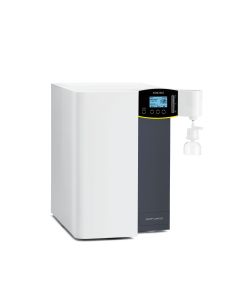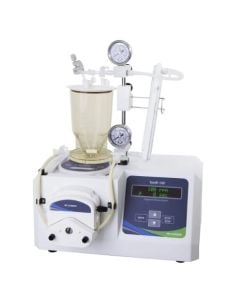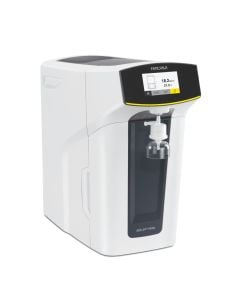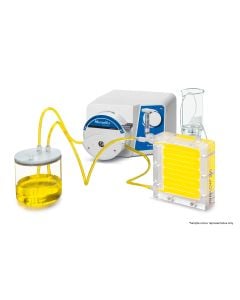
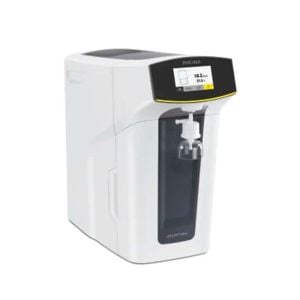
Sartorius Arium® Mini Essential UV Starter Set, with all the required components
 Powered by Bioz
Key Features
- Ideal for small labs requiring <10 L/day of ultrapure water
- Large touch display with self-explanatory navigation
- Take up a small footprint—only measures 28 cm in width
- Volume-controlled dispensing in 50 mL steps
- Delivers up to 1 L/minute
- Produces ASTM Type I ultrapure water
- UV lamp effectively destroys organic compounds
Using high-quality water ensures the reproducibility of your results and prevents time-consuming repeat analysis. These compact Arium Mini systems only measure 28 cm (11") wide to easily fit on a benchtop. A high-resolution, touch-activated color display featuring self-explanatory icons is easy to navigate even while wearing gloves. Store favorite functions such repeated dispensing of identical volumes to help increase efficiency while minimizing errors.
Connect Arium Mini Essential water purification system to pretreated (RO, DI, or EDI) water line to produce ASTM Type I ultrapure water. Type I ultrapure water is useful in buffer, media, and reagent preparation and histology, ELISA, AAS, IC and photometry applications. The integrated UV lamp (185/254 nm) helps reduce total organic compound (TOC) to =5 ppb, making it ideal for analytical applications such as SPE, ICP-MS, GS-MS, LC-MS, and HPLC.
| ASTM | Water GradeType I |
| Water Purification Method | Adsorption by spherical activated carbon, catalyst, reverse osmosis, ion exchange, optional UV irradiation, and by point-of-use particle-removing filtration |
| Max Flow Rate (L/min) | 1 |
| Inlet Port | 0.25" OD tubing |
| With UV Lamp | Yes |
| Source | Pretreated RO, DI, or EDI water line |
| Type I Water (Resistivity) | 18.2 MΩ × cm |
| Feed Water Requirements (Conductivity) | < 100 μS/cm |
| Type I Water (TOC) | ≤ 5 ppb |
| Feed Water Requirements (TOC) | < 50 ppb |
| Feed Water Requirements (turbidity) | < 1 NTU |
| Type I Water (Conductivity) | 0.055 μS/ |
| Type I Water (Bacteria) | < 0.01 CFU/mL |
| Feed Water Requirements (pH range) | 4 to 10 |
| Type I Water (Endotoxins) | < 0.001 EU/mL |
| Feed Water Requirements (pressure) | 0 to 6.9 bar; (0 to approx. 100 psi); recommended > 2 bar (> 29 psi) |
| Feed Water Requirements (Temperature) | 2 to 30°C |
| Power (VAC) | 100 to 240 |
| Dimension (HxDxW) | 20x20.9x11" |
FAQ - Frequently Asked Questions
Here you'll find answers to our most asked questions. Still can't find quite what you're looking for, or have something we should know? Send us an email, we're happy to help!
-
Q1: Why is water quality important?
A1: If you do general, critical or life science analysis in your laboratory, impurities can have an impact on your results. For example, impurities like ions in your water can cause interference with reagents, or organic material can create ghost peaks in your chromatography diagrams. To ensure reliable and constant results, it is important to use purified water optimized for your applications.
-
Q2: What standards are used in laboratories?
A2: Standards provide direction on what quality is needed for certain applications or industries. It is important to know if you need to follow a specific standard in your application/industry. Some examples of generally used standards are the American Society for Testing and Materials (ASTM), the International Organization for Standardization (ISO), the Clinical and Laboratory Standards Institute – Clinical Laboratory Reagent Water (CLSI-CLRW) and the International Pharmacopeia (including USP, EP and JP)
-
Q3: What types of water are used in laboratories?
A3: Lab-grade water quality and purity varies. The type used depends on laboratory application. Tap water is usually too inconsistent with inorganics, organics matter, particulates, etc. to be reliable for laboratories or experiments. Laboratory water is categorized according to quality and purity. The most common lab water standard is ASTM, which categorizes the water into Type 1 (ultrapure water), Type 2 (pure, DI or general lab water) and Type 3 (primary or RO water). The different types are suited for different applications and should be used accordingly to ensure good and consistent results in research and production.
-
Q4: What purification techniques are used for water purification?
A4: Depending on which water quality is required, various technologies can be used and combined. For Type 3, reverse osmosis (RO) purification is typically used. For Type 2, it can be a combination of RO and ion exchange technology. Type 1 is mainly based on ion exchange on already pretreated water (either Type 3 or 2). These processes can be further optimized with additional components like activated carbon, ultrafiltration, UV-lamps, etc. Add-on steps depend on the applications for which the water is used. Generally, Type 3 or Type 2 water is used for feeding instruments or preparing non-critical solutions, whereas Type 1 water is used for all critical applications, like analytic or life science.
-
Q5: What are the different types of laboratory water?
A5: There are different types of water varying by quality and purity. Water purity is categorized according to general standards (e.g. ASTM, ISO) from highest to lowest as Type 1 (ultrapure water), Type 2 (pure, DI, or general lab water) and Type 3 (primary or RO water). In the Pharmacopeia, water is categorized as Purified Water (WP) and Water for Injection (WFI).
-
Q6: What type o water should be used for which application?
A6: Lab Applications can be divided into three categories in terms of laboratory water: analytic and life science applications, general and feed water. For feed water applications, (such as dish washers, autoclaves or Type 1 water purification systems), you can use Type 3 water. For general applications that are a bit more critical (such as sample, media and buffer preparation) and for less sensitive analytical methods, Type 2 water should be used. Type 2 water can also be used as feed water for autoclaves, washing or feeding Type 1 water systems. For the most critical applications, Type 1 water should be considered. For critical life science applications, a Type 1 ultrapure water system - together with an ultrafilter - should be used. If it is analytical work (sensitive analytical methods such as HPLC, ICP, LCMS), the ultrapure water system should have an UV-light implemented.
-
Q7: How often should consumables be replaced?
A7:Depending on feed water quality and consumption per day, the intervals to replace consumables may vary. Consumable and system materials will also show sign of fatigue after time and lose their properties. As a result, this might affect the quality of your laboratory water. Therefore, it is recommended to regularly perform maintenance check-ups on the system and change consumables according to recommended intervals to ensure water has a high quality and purity.
-
Q8: Is it possible to document water quality?
A8:For some industries it is important to be able to confirm the quality of the dispensed water, and there are different options how to save these data. If you need to save water quality data, make sure your system has this capability. Depending on the system, it can either be saved electronically (e.g., for Arium® SmartStation accessible through the webpage hosted by the device) or printed as a hard copy.
-
Q9: Why choose a point-of-use (decentralized) water purification system over a centralized system?
A9:Using a centralized system means you are feeding water to a whole building. However, with a centralized system it is difficult to control the values and quality of Type 1 water. Therefore, it is recommended to have a Type 1 water purification system at the point-of-use. With a decentralized system, it is possible to qualify the water, giving you control over your lab water’s reliability.
-
Q10:What is the difference between electrode ionization and io exchange?
A10:Electrodeionization, also called EDI, is a technology typically based on a combination of ion exchange and electrodialysis. Thereby ions are not only separated by ion exchange resin but also with the help of an electric current. Compared to a classical in-exchange process, the electrodeionization supports the automatic regeneration of the used ion exchange resin.
-
Q11:Can I integrate lab water systems into the furniture?
A11:Yes. As each installation is slightly different, our application and service teams will be able to help you plan and accomplish the integration of your water systems into your lab furniture.
-
Q12:Can a water purification system be used in a clean room?
A12:Yes, but to minimize the risk of contamination by particles, etc., the system should be separated from the dispense device when possible. The producing unit should be kept in a separate room and connected with a dispensing unit placed in the clean room. The installation should, however, be done with a service technician, as everything needs to be adjusted to local conditions.
-
Q13: Why do you need a final membrane filtration at the point of use?
A13:Typically, this is used as a last protection step. The final filter removes any remaining particles > 0,22 µm and filters out bacteria. Furthermore, most final filters are assembled with a safety bell to protect the product water outlet from contamination, e.g. getting in contact with uncovered skin etc.
-
Q14:If our feed water source is very clean and pretreated, which is considered the best period for changing the consumables of the system?
A14:This depends on the system type and consumables which are used. The lifetime of the used filter materials and the amount of material inside the cartridges can influence these intervals. The quality of the feed water impacts the life of the consumables; however, even if there are just small variations in the feed water, it could significantly impact the used consumables, depending on the composition of the impurities.

Check out other related products below!